Walter Simmons Robb Family

Friday, January 28, 2011

William Robb and Ellen Bell and Susannah Drummond

Helen or Ellen Bell Robb
Ellen Bell was born in Perth, Scotland, on June 30, 1819, the daughter of Margaret Monroe and William Bell, and the granddaughter of Isabella McLaughlin and Robert Monroe and Helen Normand and William Bell. (She was christened “Helen” Bell, and that is what is on her gravestone; however, she is referred to by the family as Ellen, and that is how we shall refer to her in this history.”

William Robb, born on January 15, 1815, in Caas of Cowry, Scotland, was the son of James Robb, a well-to-do farmer who was killed by the kick of a horse, and Christian Ewan Robb, who lived to be 100 and was buried in Kendoul Churchyard in Scotland.

Kendoul Churchyard
James Robb  and Christian Ewan Robb his Spouse
James Robb who died at Barnhill
Also, in memory of their son John who died 1 May 1830 age 20  

After William (22) and Ellen (18) were married on August 23, 1837, William bought a coach making and repair shop with his savings and part of her dowry, and in this shop he plied his trade. A family story has it that he first repaired and painted coaches for Queen Victoria and later actually built them.

The class structure in the United Kingdom was very rigid. Upon the death of the elder Robb (date unknown to us) William’s older brother Thomas was appointed by King William IV as “Squire of Bramblebury.” Thomas was suddenly important, and since he was now richer and in a higher class than William, he did not speak to him again, although, given William’s famous temper, there may have been additional reasons for the rift. Brother James, also richer than William, remained on friendly terms with him. Sisters Belle and Jane, both of whom married lower-class men, stayed on friendly terms with William and James, possibly Thomas as well.


Shortly after the birth of Ellen and William’s first child, James (September 12, 1838), William decided to take advantage of the government’s offer of free land in Australia, in the area known as New South Wales, for “free settlers and convicts.” Things were not going as well as William wished, and his quick temper also caused problems in his profession: once, in the throes of anger, he threw a wrench through the dashboard of a coach and had to rebuild it. 
New South Wales
William sold his business, invested the capital in hardware and household goods, and, along with his brother, James, prepared to move his family across the seas. It was hard for Ellen to leave her family, to whom she was devoted, and although they corresponded, she was never to see them again.

The sailing ship to Australia took eight months. It was a difficult voyage, being delayed by a fierce storm and the resulting shipwreck at the Cape of Good Hope on the tip of Africa. Relatives in Scotland were greatly grieved by the first message that all hands on board had been lost in the disaster, and they were much relieved when the correct news came through at last.

Once in Sydney, the Robbs’ fortunes improved. William was given a tract of land by the government and provided with convict labor to improve it. At the same time, he and Ellen set up adjacent stores, William managing one which traded in tools, coaching building and hardware, and Ellen trading in dishes and household goods in the other. Listed in the 1847 Sydney directory is William Robb, Coachbuilder, 325 George Street, with the stores listed at 397 and 399 George Street.

The family flourished in Australia. Business grew as did the family: William Jr. (1841); Albert (1843); Ellen Matilda (1844); Ann (1846); Thomas (1848); John (1850); Alexander (1852); and Adam (1853).

In 1850, the year that John was born, James, then 12, was having trouble in school, being unable to get along with the other boys and engaging in numerous fights. In an effort to discipline him, William gave him several “licking’s.” While the family blamed inadequate medical care for his failure to recover, Williams always regretted he had been so severe, because James died shortly thereafter.

William did have his violent and temperamental side, but he also had a kind and caring side. After he and Ellen converted to the Mormon Church, their home was always open to missionaries and other Mormons, and at one time it was the district headquarters for the Church. Once a young missionary fell ill, and the Robbs cared for him in their home until he died. Because his body could not be shipped home, William paid all the expenses for his burial in Australia. He also financed the way for many needy friends to go to Utah while he and Ellen made their plans to emigrate.

Ellen was not only the loving mother of seven (surviving) children: she was also a successful businesswoman. She sent the money she earned from her store - which also carried luxury chinaware - to Utah by returning missionaries as a loan to the Church. There is no record that these funds ($6,000) were ever returned to her or her family.

In 1855, the family story took a different shift. Sixteen year old Susannah Drummond took a job as a clerk in William’s store. A lovely girl with dark hair and blue eyes, she enjoyed the acquaintance of William Robb Jr., two years younger than she. The romance was short lived, however, since William, Sr. forbade his son to visit her again. In fact, when he found his son “sparking” Susannah, he thrashed him soundly...  in spite of Ellen’s pleas for mercy. William, evidently furious at his son’s interest in a girl he wanted, upset his son to the point that William, Jr. left home, vowing never to return. Susannah moved into the Robb household as a domestic. William Sr.’s interest in her grew.

That same year, 1855, Ellen gave birth to another son, whom William named George Drummond Robb after Susannah’s father. One can imagine Ellen’s reaction to all this.

Susannah’s father was the son of an English gentleman, while her mother, Susannah Jenkins, was the pretty daughter of a gardener or farmer. One day when George Drummond was out hunting, he met Susannah and they fell in love at first sight, marrying in 1835 against the wishes of his family. They made their home near her parents.

The first years of their married life were happy. A daughter, Sarah, was born in 1839 when George left on what was to be a short business trip. He never returned. As the weeks stretched into months, Susannah gave up all hope of ever seeing her husband again. When her daughter, whom she named Susannah, was born on November 13, 1839, Susannah Drummond had neither the strength nor the desire to live. She died soon after and was buried in Bath.

After their mother’s death, the two little girls were taken in by Susannah’s cousin, William Hawkins, and his wife, Eliza, who were childless. The children called them “Aunty and Uncle Hawkins.” The Hawkins couple decided to take the girls to Australia because they were afraid the Drummond family might try to claim them.

At the time Susannah moved in with the Robb family, the doctrine of polygamy was becoming more widely known and was taught to the faithful in Australia as well as other places around the world. Since Susannah’s guardians, Aunty and Uncle Hawkins, had joined the Church along with Susannah, they were neither surprised nor dismayed when William asked Susannah to be his polygamous wife. She consented, and although William had been married to Ellen for twenty years, was 42 years old, and had fathered ten children, he married eighteen-year old Susannah in 1857, a Mormon missionary presiding. Certainly, the marriage had no standing under British law.

William’s children were aghast. Until this time, William and Ellen had had a close relationship, working together at home and at the shops, planning together for their eventual trip to Zion. Already upset with their father for the death of James and the thrashing and alienation of William, Jr., the older children were further troubled by this marriage to a young girl which was so distressing to their mother. When Ellen protested against the marriage, ...she threatened to leave him and go by herself to Utah, where she felt her money on loan to the Church would provide for her family. At that, William decided to go there immediately with the family.

William sold the businesses for a reported $50,000  and the family bought clothes, food, seed and all other necessary goods for their new home. They bade goodbye to William’s brother James, his family, and other friends in Sydney, and on June 27, 1857, they left on the sailing ship, “Lucas,” Captain J.C. Dagget in command.

Susannah’s sister Sarah had married a sailor named Richard Rillstone, who signed onto the “Lucas” as one of the crew, which paid for his passage over. Aunty and Uncle Hawkins also came along, and William paid the fare for several returning missionaries as well.

In the Robb party in addition to William, Sr., were Susannah, then three months pregnant, and the gallant Ellen and her eight surviving children: William, Jr. (16); Ellen (13); Ann (11); Thomas (9); John (7); Alexander (5); Adam (4); and baby George (2). Certainly, Ellen had her hands full, especially considering that her husband was in thrall over his pregnant teen-aged bride.

Because of bad weather, it took 108 days (over three and a half months) to cross the Pacific Ocean, and many of the passengers were sick all they way. When the ship docked in San Pedro, California, on October 12, 1857, Susannah said goodbye to Sarah, from whom she had never before been separated. Since Richard was a member of the crew, he had to complete the entire voyage, which meant traveling on to Oregon. From there, he and Sarah - and new baby William Wall Rillstone, who had been born September 22 on board ship - expected to go to Utah to join the Robbs. They never made it, and were never heard from again. Susannah wrote letters to California, Oregon, Australia and even to Scotland in her desperate efforts to trace her sister, but she never found her, finally concluding that the Rillstones had lost their lives at sea or at the hands of Indians. This loss was a lifelong tragedy for Susannah, who waited and waited for that longed for reunion.

Once in San Pedro, William loaded the family possessions, which included a considerable sum of gold placed into packs, into a hired wagon and took the family to San Bernadino. Ellen and William stayed with a doctor friend from Australia while final preparations were made to cross the desert to Utah. Susannah remained with the Hawkins in a camp near the edge of town so she would not be discovered as a polygamous wife.

San Bernadino had been established in 1851 as an important link on the journey from San Pedro to Salt Lake City. About a month before the Robbs’ arrival there, the Mountain Meadows Massacre (in which the Fancher party on their way west were cruelly murdered by a group of Mormons) caused such anti-Mormon sentiment that Mormons in outlying areas were called home to Salt Lake. Some 90% of the three thousand Mormons then living in San Bernadino packed up their belongings, sold their holdings - usually at a loss, if they could find buyers at all - and made the long journey back to Salt Lake. The Robbs arrived there in the midst of all this turmoil and at a time when many Mormons had already departed.

Shortly after the Robbs arrived in San Bernadino, an angry mob gathered in the area and threatened to tar and feather the newly arrived group. The Robb’s friend, the respected doctor, stepped out his front door with his gun and told the mob that these new arrivals were his friends, “that they had been on the high seas when the massacre was committed, and that they could not possibly have had anything to do with it. If you (the mob) want to come into my home to take them, it will be over my dead body.” The mob dispersed, but the travelers didn’t know how much longer they would be safe, so they made immediate preparations to move on.

When the sun greeted them the next morning, they already had a good start, and by the time they camped that night and were finally able to rest, they were all physically and mentally exhausted.

Along the way, the company was ever watchful for wild beasts, hostile Indians, and threatening anti-Mormon gangs, standing a guard every night as a precaution. They did meet many Indians, but none seemed especially hostile. The pioneers treated the Indians in a kindly fashion, giving them food and clothing. At one camp, the immigrants cooked a huge pot of cornmeal mush, and shared it with the Indians. The children were greatly amused to see the Indians try to eat this soft food with their fingers. The Indians refused to use spoons, which were offered, and even scorned the use of cups and bowls. Only if there were too many to gather directly around the pot would they accept these smaller containers.

While camped on the Mojave Desert near the Colorado River, Susannah gave birth to her first child, a little boy she named Mojave. She was delighted, as she loved the baby dearly and felt she had a family of her own at last.

The first white men the travelers met on their journey were some missionaries in Santa Clara, Utah, a tiny place on the Utah - Nevada border just a bit north of Arizona. Under the leadership of Joseph Hamlin, the missionaries were trying to become friendly with the Indians and teach them to farm.

The party traveled on. Baby Mojave was sick, and on Christmas Day at Cedar Fort (now Cedar City), he died. Susannah was heartbroken to lay her baby away in the desert land so far from home.

One week later, they reached Paragonah. It was New Year’s Day, 1858. The six-week journey from San Bernadino to Paragonah had been a continuing nightmare for Susannah, suffering through the final weeks of pregnancy, then childbirth, nursing her sick baby, and finally watching him die and burying him. No doubt, she wished she had her sister to comfort her. The whole trip from Sydney to Paragonah had taken over six months.

In 1857, Paragonah was a small Mormon community in Iron County, Utah, some 24 miles north of Cedar Fort. Residents of Parowan, about four miles southwest of Paragonah, had assembled this new village a few years earlier, but because of Indian problems, permanent homes in Paragonah were put off. A fort was laid out and completed in 1855. Made of adobes, it was 100 feet square and two stories in height. The lower walls were three feet thick and the upper walls were two feet thick. There was only one entrance to the fort and no outside windows were placed in the lower story, though several were inserted in the upper story to serve as observation points as well as for light.

The newly arrived group from Paragonah moved into the fort, as Indians were still troublesome. The dwelling houses were connected with the outside wall of the fort, but extended all around the fort facing the center. Each family was given rooms according to the number of family members, and the northeast corner was a large room which served as church, school house and amusement hall.

On November 4, 1858, Susannah’s second child, Samuel, was born and he was to be her only surviving son. Ellen gave birth to her last child, Carrie, on July 19, 1859, but Carrie died shortly after birth.

Life in the Paragonah Fort was simple, but there were periodic diversions. Thursday evenings, there were prayer meetings. On other days, there were spelling bees, and the women had spinning bees where they made raw wool into yarn to be woven into cloth. They took turns holding these bees in each other’s homes, and were rewarded with supper.

Each family had a few milk cows which were herded and guarded on the meadows by the men, while the women were given turns to use the milk to provide butter and cheese for their families.

[Once, on the Fourth of July, it was Mary Prothero’s turn to make cheese. The Protheros were from Wales and were relatives of the Edwards family; they were also among the first and most prominent residents of Paragonah. Mary’s daughter, Susie, had a new pair of shoes, but her mother lent them to another girl to wear to the celebration since they wouldn’t be going. When the cheese was in the press, however, a neighbor invited the Protheros to go to the dance with them. Susie was nearly in tears as she sat at the dance, trying to keep her bare feet covered while her new shoes danced gaily over the floor on the other girl’s feet. From Ilene Kingsbury’s Paragonah Patrols.]

In fact, the community was as united as one big family in their work. The men, when going to the canyons for firewood, went in companies or squads of six or eight. This was a time of suspense, lest their stock or crops be destroyed, and preparations were always considered for attacks which might be made by Indians.

Eventually, a corral was built just north of the fort, it too having high walls for protection, and the men took turns guarding the stock in the corral at night and on the meadows by day. The fort was considered one of the strongest and safest forts in the area, and was occupied until 1862. In 1860, a town site was measured off, and by 1862, new homes were being built and people were leaving the fort.

William Robb is said to have built both Ellen and Susannah a log house, which stood side by side on the property east of and across the road from the fort, on the south corner of the northeast block. The date was probably about 1861.

Some family writers have suggested that Susannah and Ellen “became good friends” during this time because they shared “the hardships of pioneer life.” There is, however, considerable evidence of bitterness on the side of Ellen’s children so this “friendliness’ is somewhat unlikely.

Not long after his arrival in Paragonah, William was summoned to Salt Lake by Brigham who had learned of the “fortune” in gold coins that William had brought from Australia. Brigham persuaded William to make a large loan to the Church for the purpose of financing wagon trains from Missouri. (The ill-fated handcart companies convinced Brigham that needy converts needed more assistance, and the practice had started of sending fully-equipped wagon trains out from Utah to meet the pioneers at the Missouri River.) A dispute as to whether the funds exchanged were a loan or a gift eventually led to a serious breach between William and the Church.

1861 was to prove an eventful year. On April 15, Susannah gave birth to her first daughter, Isabelle, who was known as “Baby Bell.” Then, in October, during the Conference, Brigham called William Robb, among others, to go to the Cotton Mission to Washington County, in order to help settle Utah’s Dixie. It was Brigham’s hope to make the entire Mormon country self-sufficient, and he was optimistic that the climate and soil in Dixie would be good for growing cotton.

At first, William was reluctant, because he liked the life in Paragonah and had seen the small rocky valley he was being sent to, the many hills and sparse vegetation, except for greasewood and cactus. The decision was a hard one. Some family accounts say the decision was reached by “family discussion.” According to William, Jr., his father “deserted Ellen as they were not getting along well since the polygamous marriage.” No doubt, the lack of harmony between his two families, his obvious preference for his younger wife, and his desire to follow the dictates of the Church were all factors leading him to decide to go.

 It was then decided that William and Susannah and their two children would go to Harrisburg, a village in the Dixie area, while Ellen and her eight children would remain behind in Paragonah. William Jr., also called Bill, was put in charge of the farm and cattle, with the aid of his younger brothers: Thomas (14); John (12); Alex (10); Adam (9); and George (7). Ellen and her daughters, Ellen (18) and Ann (16) had many tasks of their own. They sheared the sheep, then spun wool into yarn which they then wove into cloth for the family clothing. The vegetable garden provided food and livestock yielded milk for butter and cheese. During the summer, the family lived down on the meadow in a log house so they could more readily look after the cattle, taking the excess cheese and butter to Salt Lake to be sold or traded for things not easily available in a small town.

Some time after 1864, Ellen had a big brick house built for her family, hiring the Spillsbury boys from Toqueville to build it. It was one of the first brick houses in Paragonah. Two stories high, it had four large rooms, each with its own fireplace, and was still standing in 1967, when JTW III and June visited the area.
Helen Bell Robb Home
Paragonah, Utah
Ellen was very proud of the beautiful dishes she brought from Australia and had a special cupboard built to display them. The townspeople, men as well as women, called on her to admire them. Since there was not occasion in Paragonah for Ellen and her daughters to wear the silk and satin brocaded clothes they brought with them, they sold them to the women in town to be made into fancy hats. The Robb women were content to wear homespun dresses and knit stockings, just like the other pioneer women of the day.

1864, the Edwards family arrived in Paragonah from Wales and the two families got acquainted. Both Sarah Edwards and Ellen Robb were strong women, each with a large family to care for alone, and they had much in common. Not long after their arrival, Sarah’s oldest son William married Ellen’s daughter, Ann (1868); then, in 1875, Ellen’s son, John, married Sarah’s daughter, Sarah Ann. [In 1864, Ellen’s older daughter Ann, who had married a man named Anderson, died, and Ellen was grieved, for she was close to her girls.]

Meanwhile, William and Susannah (22), Samuel (3), and Baby Bell (1) left for Harrisburg in the Spring of 1862. They traveled with two covered wagons, one drawn by a mule team and the other by oxen, bringing with them food, clothing, grain, vegetable seeds, axes, shovels, hammers, nails, a plough, hoe, and anvil. The trip took four days - a distance of about 60 miles. Susannah hated to leave Paragonah, especially since Aunty and Uncle Hawkins had settled in Beaver, Utah, some 30 miles the other side of Paragonah, and visiting with them now would be even more difficult.

William and Susannah Robb Home
Harrisburg, Utah
For their home, William chose a knoll overlooking the valley, and he and Susannah worked hard building a two-room house out of hand-cut sandstone bricks. Flat rocks were placed side-by-side to make the floor as level as possible until lumber could be secured o make a wooden floor. Both rooms had a huge fireplace, and the door that faced north led to the living room.

While they were building their home, the family lived in one of their covered wagons which had been set into the ground. That first spring and summer were spent clearing the ground of rocks and planting crops. After the harvest, the home was completed before winter set in.

Harrisburg had been settled by Moses Harris, an early settler in San Bernadino, on the Virgin River near Quail Creek, but flooding drove the settlers further up Quail Creek to the Cottonwood Creek fork. The location and climate seemed ideal for a good life: crystal clear water for domestic use, crops and livestock; a splendid forest of pine timber to provide firewood just a day’s ride away. However, it proved hard to wrest a living from this desert country. The spring gave little water, and it was a problem getting the water to where it was needed most.

Even so, Susannah was happy in her new home. She was proud of the fine, big fireplace whose flickering firelight often provided the only illumination at night, since candles were not always available. They were considered “modern conveniences” in those days. Susannah learned to spin and weave; she became adept at cooking over the open fireplace; she knit sox and sewed dresses, shirts and trousers. The family bought shoes from the local shoemaker, but went barefoot as much as possible to save the shoes. Cotton, molasses, honey, fresh and dried fruits, brooms and straw hats were sent to Iron and Beaver Counties in exchange for potatoes, cheese, meat and candles.

The years went by. It was Susannah’s and William’s sorrow to lose two more children during those years. Susannah born in January, 1864, died in October that same year; and Albert, born in September, 1866, lived only 19 months. Both babies were buried in the little Harrisburg Cemetery just south of the Robb home.

A month after Albert’s death, William took the grieving Susannah to the Endowment House in Salt Lake where they were married for time and all eternity (“endowed”) and their three dead babies sealed to them, as were Samuel and Isabelle. Susannah was comforted by the belief that the time would come when she would again hold her babies in her arms.

Baby Bell was seven and Samuel almost ten when Lydia Ann was born on October 31, 1868, and the family’s prayers that the new baby be granted life and health were granted. Hard times, however, came upon Harrisburg. In 1869, a grasshopper plague, a Navajo raiding party and low water caused many of the Robbs’ friends to leave Harrisburg. In the next few years, occasional flooding destroyed more valuable land, driving still more folks into the new town of Leeds just three miles away.

Meanwhile, not far way, some miners were becoming interested in the possibility of a silver strike. In 1870, a prospector named John Kemple set up the Harrisburg Mining District and started developing a mine, but in 1874, there still wasn’t much more than small scale mining. Although the boom years took place after William Robb left Harrisburg in 1874, he is said to have sold wine and meat to the small settlement in the mining area prior to his departure.

Susannah and William hoped to have another son and looked forward to the new baby due in the spring of 1873, but when the time came, Susannah became very ill. Since there were no doctors or nurses nearby, the only help came from a neighbor, and Susannah gave birth to a stillborn son on April 26. Hemorrhaging badly, she knew she was dying and asked her grief-stricken husband to bring the children to her. She told Samuel to be a good boy, comfort his father all he could, and help Bell look after the little girls. Bell was so sad and frightened she could not go to her mother, instead creeping away to cry alone. Kissing her two baby girls goodbye, Susannah spent the last few moments alone with her husband.
Susanah Drummond Robb and baby boy
Harrisburg, Utah Cemetery
She was laid to rest, her baby boy in her arms, in the Harrisburg Cemetery, next to the graves of two of her children. She was only 33 years old, had borne eight children, lost four of them, and had done her best to carry the burdens of her short life. On her tombstone is inscribed:

In Memory of Susannah Robb
Born Nov. 13, 1839
Died April 26, 1873
Farewell dear Mother Sweet they rest
Weary with years and worn with pain
Farewell till in some happy place
We shall behold they face again.

William stayed in Harrisburg for less than a year after Susannah died. Samuel, who turned 15 the fall after her death, and Bell, who turned 12 just before, did their best to help with the farming and other chores and help care for Lydia Ann (4) and Eliza Jane (2) but it was more work than they could manage. William brought the family back to Paragonah to get Ellen’s assistance, but she couldn’t do much, since she was ill. She tried, but on April 11, 1874, shortly after William and the children returned, Ellen died at the age of 55.

Ellen, like Susannah, had had a hard life. She had given birth to eight sons and three daughters and lost four of them. She suffered the heartbreak of losing a husband of twenty years to a teen-aged girl, and she raised her children virtually alone for the last thirteen years of her life. A fine business woman, wife and mother, intelligent and courageous, Ellen Bell Robb carried her responsibilities and heartaches with strength and dignity. (her portrait, which reveals a lovely, clear-eyed, steady woman of grace and intelligence.)

William lived in Ellen’s big brick house with Susannah’s four children, Ellen’s children being grown and independent by this time. Bell took care of her father until he died. After his return to Paragonah, William made an effort to gain back some of the money he had loaned the Church, and was offered some cattle as payment. When he went to Strawberry Valley to obtain the cattle from the Church herd, he was allowed to chose only the scrubs. His account was then credited at the rate of $79 a head, while the going rate for good cattle was between $10 and $20 a head. William felt the Church had cheated him royally.

He sometimes refused to wear a shirt, either wearing a burlap one he made himself, or doing without one altogether. Once he went shirtless for several days and contracted pneumonia. (One family story has it that this is what led to his death.) His family would visit him in his big house and bring him clean clothing, but he would toss it aside. A tall man with a full red beard, William was free-hearted, had a terrible temper, smoked a strong pipe, talked with a marked Scottish brogue, and hated April because he thought it was an unlucky month.
William Robb
Parowan Utah


Note:  This history has been edited by the publisher

Saturday, January 1, 2011

Kinnoull Parish Church

Kinnoull Parish Church
Dundee Road, Perth, Tayside, Scotland
Kinnoull Parish Church Yard, Perth, Scotland,  burial place of James Robb (1785-1859). 
KINNOULL PARISH CHURCH - The earliest recorded reference to Kinnoull Parish Church appears in Bagimond's Roll, a Papal taxation, of 1287. Although in the diocese of St Andrew's, it was not one of the churches mentioned as having been consecrated by Bishop David de Bainha in the middle of the 13th century. However, this is not to say that the parish did not exist or that there was not a church.


The site of the original church building is uncertain. The "old church" at Wellbank, vacated on entry to the present building, was itself a renovation, carried out in 1779, of an earlier building on the same site. This building must have been in existence in 1635 since the statue of the first Earl of Kinnoull was erected in it in that year. The "old church" with its statue and graveyard now form an integral part of the Norie Miller Walk.

By the early 19th century it was recognised that, due to the dilapidated state of the "old church" and a rapidly growing parish, a new, larger building was required. The present building was opened for worship on Sunday 15th April 1827. It had cost £3,873 15s 6d to build. A new manse was built in 1829. This was sold in 1986. The church hall was built in 1901.

The stained glass windows within the church belong to several periods. The large west window, "The Millais Window" (pictured above), which faces one on entry by the main door, was presented by George Gray of Bowerswell in 1870. Its design was based on drawings made famous by his son-in-law, Sir John Everett Millais, President of The Royal Academy. The painted glass panels make up a series of 14 separate Parables of Our Lord.

The east window above the main door, presented by Miss Alice Anderson, depicts the Nativity, Christ calling the Disciples, Christ appearing to the Disciples following the Resurrection and Christ at Emmaus. The window was dedicated in 1933.

In the south west corner of the church are two memorial windows. The one on the west wall, commemorating the Rev John W Henderson, depicts Jesus' baptism, the raising of the widow's son, the Crucifixion with the figures of Mary and John at the foot of the Cross and Jesus with Mary Magdalene in the garden. The south window, commemorating Mrs Margaret Anderson, includes the figures of David and Isaiah, The Annunciation and the Presentation in the Temple.

The west window of the south transept, commemorates the Rev William Hume, and was installed in 1973. It portrays St Columba and St Ninian (pictures below), the two saints principally associated with the spread of Christianity throughout Scotland.

In the north west corner of the church is the Boys' Brigade Centenary Window, presented to the church by its Boys' Brigade company, the 3rd Perth, in 1989 (picture below).

In 1977, the 150th anniversary of the opening of the present church building, substantial changes were made to the interior layout of the church, the most significant being the moving of the organ consul from in front of "The Millais Window" to its present position. The pulpit was also raised. In 1957 the organ had been completely rebuilt. It was extensively renovated in 1995.

In 2002, the 175th anniversary of the present church building was celebrated, with a number of congregational Special Events.

Over the past few years the Church and its buildings has been subject to a programme of continuing maintenance to preserve the buildings for future generations. The Manse had a new utility room added, the Hall had a new heating system installed and the ground floor windows replaced. As the building is a 'Grade 2 listed building' special consideration had to be made to the type of windows installed. The most recent Church upgrade has been the renovation of a number of stained and plain glass windows to ensure their preservation. During 2006, 12 windows were removed, refurbished and restored. This included the "Millais Window". The refurbishment work for this project was approximately £90,000. The windows were completed by the end of 2006 and a Re-dedication Service was held on Sunday 28th January 2007. The walls that surround the Church's gardens had some remedial work undertaken as several cracks had appeared. The next proposed large scale refurbishment work to be undertaken will be the removal and reinstating of the roof slates. Nail wear is feared and it has been recommended that this work be completed within a 5 year time frame. Fund raising is on-going to ensure that this can be completed.
_____________________________________________
Source:  http://www.kinnoullparishchurch.co.uk/history.html
 
See Video of Kinnoull Churchyard Perthshire Scotland
http://perthshire.blogspot.com/2007/12/kinnoull-perthshire-scotland.html

Tuesday, December 14, 2010

Christmas in Scotland

Snow covered Royal Mail
The Scottish people have their big celebrations on New Year's Day, called Hogmanay. A long time ago there is a superstition that it is bad luck for the fire to go out on Christmas Eve, since it is at this time that the elves are abroad and only a raging fire will keep them from coming down the chimney.

On Christmas day, people sometimes make big bonfires and dance around them to the playing of bagpipes. Bannock cakes made of oatmeal are traditionally eaten at Christmas.

In Scotland, Christmas had traditionally been celebrated very quietly, because the Church of Scotland - the Presbyterian Church - has never placed any great emphasis on the Christmas festival, However, the Scots are members of the Church of England or other churches generally celebrate Christmas in the same way as the English people disapproved of Christmas for they believed that there was too much riotous festivity that went on. Nowadays these things are held at Hogmanay, but they do celebrate Christmas with some very interesting customs.

The Scots celebrate Christmas rather somberly and reserve their merriment for New Year's Eve which is called Hogmanay. This word may derive from a kind of oat cake that was traditionally given to children on New Year's Eve. The first person to set foot in a residence in a New Year is thought to profoundly affect the fortunes of the inhabitants. Generally strangers are thought to bring good luck. Depending on the area, it may be better to have a dark-haired or fair-haired stranger set foot in the house. This tradition is widely known as "first footing."


Although Christmas and its customs were in disfavor for only a short time in England (during the reign of Cromwell), Scotland ignored the holiday far longer. Bear in mind that "Christmas" is "Christ's Mass" and mass was banned in Scotland. There are records of charges being brought against people for keeping "Yule" as it was called in Scotland. Amazingly, this dour, joy-crushing attitude lasted for 400 years. It has only been in recent years that the Scots observed December 25 as a special day at all. So if there is a specifically "Scottish" aspect to Christmas it is that it was not celebrated!

Christmas in Scotland is now a time for going to church, food, presents, parties, holidays and all sorts of other good things. It's a time for celebration because it's the birthday of Jesus.

Planning for Christmas starts weeks before the events. Children are busy writing their Christmas lists for Santa Claus, parents are busy buying presents, cleaning the house and organising food for the great day.

Houses are decorated with tinsel, holly wreaths candles and decorations. Mistletoe is hung to catch a kiss from anyone who stands under it. The Christmas tree, decorated with baubles, takes pride of place in any household.

On Christmas eve, children prepare for Santa Claus by hanging up their stockings in anticipation of their being filled with presents while they sleep. They leave out a small glass of whisky or milk for Santa along with a mince pie. They also leave out carrots for the reindeer - particularly Rudolph - the red nosed reindeer that guides his sleigh through the dark skies. Then the children are ready to go to bed. In all the excitement children find it difficult to get to sleep. Some waken up VERY early in the morning.

Christmas day finally arrives and is marked by screams of delight at the surprises Santa has left. Once the presents are opened, many people get ready to go to church. Christmas carols are sung during the hour long service.

On return, parents prepare the Christmas lunch while children play with their toys. Christmas dinner is a time when families get together - grannies, grandpas, aunts, uncles, cousins. Once it is finished and the clearing up done, there is generally a party. People sing songs, dance or play games. All the preparation has been worth it. People go to bed happy yet exhausted. Christmas is over for another year!

A traditional Christmas lunch will include - Starter: Scotch Broth or Smoked Salmon. Main course - Roast Turkey, Sage & Onion Stuffing, Chippolata Sausages, Roast Potatoes, Carrots, Brussel Sprouts. Dessert - Christmas Pudding and Brandy custard.


YULE
by J K Annand
I'm gaun to hing a stockin up,
I'll borrow my big brither's,
It's bigger nor my sister's ane
And strang-er nor my mither's.

I'll be in bed on Yule E'en
When Faither Christmas comes.
I ken he'll wale oor chimley oot
Amang the ither lums.

On Yule richt early I'll be up
Afore the screich o day
To see what ferlies Santa Claus
Has brocht me for my play.

I hope he'll mind a cuddly bear,
And cups for dolly's tea
Wi lots o ither bonnie toys
For a guid wee lass like me.

Thursday, December 9, 2010

Journey on the Ship Lucas from the Gurr Family Record


Helen Bell Robb
From the Gurr Record of the ship journey of the Lucas. The following are the names of the Latter-day Saint converts who came from Australia on the ship Lucas June, 27, 1857 with Captain J. D. Daggett in command: From the Gurr records. William M. Wall, President; Absalom Dowdle, First Counsellor and superintendent of provisions and supplies; George Roberts, Second Counselor. The acting teachers were George Hunter and William Hawkins. Robert and Hannah Arbon, four children; Joseph and Sophia Cadd, two children: Richard and Mary Bowden; George and Elizabeth Hunter; William and Eliza Hawkins; William and Ellen Robb, eight children; Susannah Drummond, second wife of William Robb; George and Ann Burton, three children; William and Elizabeth Gurr, two children; Richard and Sarah Ann Rillstone, one child; William and Mary Ann Gingell, five children; Enoch Eldredge and Ruth Buckman Gurr, five children; John and Emma Stuchberry, daughter; George and Susan Roberts; Robert and Tresa Cochrane, three children; George Ward and Edmund Harris. Elder Absalom Dowdle inspected supplies and provisions and reported all things ready for sea on the 26th of June, 1857. June 27, Saturday: The pilot came on board at eight o'clock and gave orders to weigh anchor. Ship under way at 9 o'clock, soon after Brother Stewart Clark and Chaffin Potter had come on board. They accompanied us to the mouth of the harbor about seven miles from Sydney. Then they took an affectionate farewell bestowing their blessings upon the company. Captain, officers, and crew soon left Sydney in the distance, having a fair wind from the west, driving us at a rate of 7 knots per hour toward the East. The sea, being rough, sea sickness commenced that night and was very unpleasant. 30?President Wall made a few remarks then nominated George Hunter and William Hawkins as teachers of the company. July 2?This morning a steady gale, very rough. Most of the Saints sick. 10?After dinner Elder Dowdle and Elder Hunter weighed out provisions to the passengers such as they desired to be weighed out to them. 13?After most of the company had retired to bed they were alarmed by the heavy sea which struck the ship shaking her from end to end and half filling her upper deck with water. She sustained no damage. Pres. Wall and Dowdle went to pacify the frightened passengers. The gale lasted through the night. 17?Provisions weighed out for dinner. Elder Roberts made out a scale showing the amount of provisions for each family. Pres. Wall assisted Dowdle in serving the provisions. 18?Company in good spirits, most of the sisters sewing. 24?Friday. Blowing strong all night, still ahead. Pres-Wall spoke on the celebration of the 24th of July, but as the weather was boisterous each was to do the best he could. Elder Dowdle spoke about the eventful day. August 2?Presidency named and blessed a child belonging to Robert Hamblin. 11?A slight disturbance with two of the brethren but all was soon all right by their forgiving one another. Pres. Wall gave some good instructions on the principles of forgiveness. 15?School at 2 P.M. During tea time one of the children, daughter of John Stuchberry climbed upon an old stove, fell back and the pipe, which was loose, fell too. It struck her foot cutting it very badly. 18?Tuesday. This morning wind hauled more ahead, sending us more to the West. The most dangerous part of the Pacific Ocean. At 2 p.m. had school on the quarter deck on account of sickness between decks. This day Elder Harris declined to teach any more. He stated that some of the parents found fault with him. Elder Dowdle volunteered his services. Elder Harris was not voted in to teach but kindly offered to assist Elder Roberts. 19?This morning Sophia Cadd gave birth to a son at 20 min. to 5 a.m. She is the wife of Joseph Cadd. Some of the children suffering with whooping cough. 31?Assembled between decks at 11 o'clock for meeting. At night the usual custom of the Captain coming on deck to pay his respects to the passengers and many received a good sprinkling. A good time while it lasted. September 6?Three children were blessed. First, the son of Robert Cochrane by Elder Wall and named Charles Rich Cochrane, born on ship Lucas Aug. 16th. Next the son of Joseph Cadd, blessed by Elder Dowdle, named Heber Cadd, born on ship Lucas, August 19th, and another son of Joseph Cadd born April 6, 1856, named Joseph Cadd. 14?This evening at 20 minutes to ten Sister Gingell gave birth to a son. All mothers that have given birth to children on board have been delivered about 20 minutes after being administered to. 17?Prayer by Elder Dowdle, he also made a few remarks for the Saints to prepare themselves for the trials that were yet before them. Exhorting them all to faithfulness. 22?At 5 min. past 3 a.m. Sarah Ann Rillstone, wife of Richard Rillstone, was delivered of a son on board ship. October 9?Friday. Fair wind, going along 5 knots. About 3:30 p.m. sighted land?first land since we saw the Three Kings north of New Zealand. Peace reigned throughout. 10?Passed three islands also sighted the coast of America. 12?This morning wind light, weather fine. Anchored in San Pedro Bay. Pres. Wall went ashore to arrange about the accommodation for the company. In the evening prayer with singing. 13?Tuesday: Most of the company went ashore with their baggage into the rooms that were engaged for the company for a week, until teams arrived from San Bernardino. Elder Wall and Robb started off to San Bernardino to get teams to convey us there, but after arriving at Los Angeles they met some of the brethren with their teams who agreed to come to San Pedro to assist us in moving to that place. The company left San Pedro in the afternoon and stared for a place about three miles distant to water the cattle, while Brother Wall and Robb stayed at Los Angeles. They were in great danger from some who had apostatized from the Church. They beset the houses round about but the Lord protected them and they got away safe and arrived before the teams at San Pedro. The next day we started for a place called Mente. Arrived there at nightfall. One wagon broke down and we stayed one day at Mente, till more teams could be got. The next day at about 3 P.M. arrived at San Bernardino. We soon got empty houses and on Sunday we were received by the people by vote put by President Cox. ?Rosella L. Gurr Mary Ann Woodhams Gingell, my great grandmother, was born in Hastings, England. Her parents were David Woodhams and Lucy Richardson. The Gingells moved to Camden, Cook County, Australia where four children, Charlotte Elizabeth, Eliza Jane, Henry Twaits and David were born. They then moved to Sydney where Stephen, William, James George, Sarah Mary, and Joseph came to bless their home. In 1857 William and Mary Ann and five of their children, having identified themselves with the Church of Jesus Christ of Latter-day Saints, set sail for America on the ship Lucas. Mary Ann gave birth to her tenth child on the high seas whom they named Josiah W. Onboard were many converts and several missionaries who were a great source of comfort and inspiration to the weary travelers who were not accustomed to such hardships. After arriving at San Pedro the company rested for a short time and then made preparations for the trek across the plains. The Gingells arrived in Utah in 1857 and soon moved to Parowan, and later to Paragonah where they arrived New Year's Day, 1858. In this little community they endured all the hardships of pioneering. Sometime between 1861 and 1870 they moved to Evanston, Wyoming. Their first home was built of logs brought from a camp near Piedmont. The first marriage in Evanston was held in this home. The young couple were David Gingell and Caroline Jage. It was solemnized by Rev. Mr. Stevens, a clergyman of the Episcopal Church who had stopped in Evanston for a few days. Mrs. Anderson, Genealogical Secretary in Evanston in 1953, says of her great-grandmother: "As a little child I can remember Mary Ann Woodhams Gingell, then quite old, going with her small bag to the homes to help deliver babies as she was a midwife." Mrs. Gingell died in Evanston, Wyoming?D.U.P. Files William Madison Wall, son of Isaac Wall and Nancy Liddiard, was born September 30, 1821, in Rockingham County, North Carolina. At the age of seven years he was left an orphan and for a short time went to live with his uncle. He then lived with a family by the name of Haws and when nineteen years old married their daughter, Nancy. They were married June 7, 1840. She was born August 23, 1823, in Wayne County, Illinois. They heard the teachings of Elder Arvel Cox and joined the Church of Jesus Christ of Latter-day Saints in 1842. The family was living in Nauvoo at the time of the persecutions of the Saints and during this time a baby girl was born to them whom they named Nancy Isabelle. In the spring of 1850, they left with their five childrenfor the long journey across the plains to Utah. They entered Salt Lake City in September of that year. William was soon called to help settle Provo. In June, 1851, he was ordained Bishop of Provo Third Ward and that same year was chosen a captain under Col. Peter W. Conover in the Walker War episode. His duties called him away from home many months at a time laboring in the Tintic district to help keep the Indians in that section. He was a member of the first city council of Provo and the first sheriff of Utah county. In 1853 he married Elizabeth Penrod. William served two missions to Australia and was in charge of a company of Saints on board the ship Lucas which left Australia June 27, 1857. It was he who converted Enoch Gurr and family and they came to Utah with that company. He married two of the Gurr daughters, Susannah and Sarah, my grandmother, in 1864. Previous to this time he had also married Emma Ford. Mr. Wall and Enoch Gurr helped build the first road through Provo Canyon and later Mr. Wall operated the first toll gate there. About 1864 he moved to Charleston, Wasatch County where he became engaged in stock raising and farming business and was also chosen president of the Wasatch Stake. He moved to Heber, then to Wallsburg, where he was made bishop. The town was named for him. During his lifetime he held many important Church and civic offices. He was a friend of the Indians and spent much time working among them. William Madison Wall died on September 18, 1869 at the age of 48 years. He was the father of thirty children. ?Ida Wall Hand Early in the Nineteenth century in a little town in Sussex, England, Northiam by name, lived a humble family, James Gurr and his wife Sarah Eldredge. They had ten children, John, William, Sarah, Enoch Eldredge, Ann, Edward, Thomas, Harriet, Mary and James. Edward and William were accidentally killed. Enoch Eldredge seemed to have possessed a little more of the spirit of adventure than the rest, perhaps because he had a friend of the same nature, John Buckman, or perhaps as we shall see from subsequent events, it was the spirit of God working on him to fulfill his purpose in eventually bringing salvation to his family and future generations. Enoch was a tall, well built man with grey blue eyes. He fell in love with and married Sarah Higgins, a young widow with a little daughter. From this marriage were born one boy, and two girls, William, Jane and Mary. When the news of the discovery of gold reached their little village Enoch and Sarah decided they would join a company going to Australia. So, in 1838, Enoch now being nearly twenty-five years of age, left England with his wife and family on the sailing ship "Amelia Thompson". John Buckman, and his sister, Ruth,were among the group. At this time Ruth was twenty-eight years old. She had studied nursing and was a mid-wife. On the way to Australia the dread disease Smallpox broke out on the ship. Everything possible was done to save the lives of those who had contracted the disease but Enoch's wife, Sarah, and their baby died and were buried at sea. The wife of John Buckman also died. They finally reached Sydney in New South Wales and started life anew. They never found gold but they found a land of opportunities. Enoch and Ruth Buckman were married about 1839. Five children were born to them. One day two strangers appeared at their home. They were invited in and after having been given a good meal, they began a long discussion on the truths of the Gospel. Many such evenings were spent and on the 23rd of December, 1853, members of the Enoch Gurr family were baptized into the Church of Jesus Christ of Latter-day Saints by John Eldredge and confirmed by Elder Graham. Other Elders came to their home including Andrew Jackson Stewart of Benjamin, Utah; William Madison Wall of Provo, Utah and Elder Fleming. They were always made welcome. When the call came from Brigham Young urging the Elders to return to Utah at the time of the coming of Johnston's Army, Enoch made arrangements for passage on a sailing vessel for America with a group of converts and missionaries. He worked as a cook on the vessel and Ruth did much to alleviate suffering among the sick on the four month's journey. The company landed in San Pedro, California and were there some time buying provisions and outfits for the journey to Utah. They were finally ready to start but one family could not procure a team so Ruth said, "I will leave my cedar chest (which was filled with clothing and linens) and they can ride with us?some of us can take turns walking." They came in the Ezra Curtis Company and suffered many hardships crossing the desert in Nevada. When they arrived in the Valley Enoch and Ruth and their children settled in Provo. He helped to build the road through Provo Canyon. Here again Ruth did much good among the sick and also helped to bring many babies into the world. After the road was finished up Provo Canyon, Enoch moved his family to Charleston, but later moved to Benjamin Ward, Utah County, where he built a log home. They were among the first settlers in this community and planted some of the first trees in that locality. Around the home they planted a willow fence which grew up to be a row of black willow trees. Enoch had been a freighter in Australia so he began hauling freight from Salt Lake City to the Douglas Store in Payson and then hauled produce back to Salt Lake City. His daughters, Susannah and Sarah, married the same man, William M. Wall. He died in Provo in September 1869 leaving Susannah with three children and Sarah with two and another expected within a few months. They were then living in Wallsburg. Because of ill health of the mother Enoch brought Susannah and her children to Benjamin where they lived in the family home. Later Sarah and her three children came to live with them. Enoch was then fifty-nine years of age and Ruth sixty. Sometime after 1872, the family joined the United Order at Prattsville in Sevier County. Enoch kept his team and wagon and two cows. He put everything else into the Order but he knew he had a great responsibility in providing for his family and the six grandchildren and working with the team brought in additional money which they needed so much. His two daughters worked hard all the time and Ruth took care of the children. She also served as midwife in the community. Enoch filed on a salt spring, got out salt and sold it, but things did not work out as expected and the Order broke up. They did not receive much as their share but they went to Richfield and joined another Order. Again Enoch put in everything he owned except the team, wagon, and a few cows. The women continued to work but soon the Order broke up and they were left without anything. Enoch and his son, Peter, rented a farm on Chicken Creek, where they went into stock raising but since there were no schools nearby for the children he decided to return to Benjamin where they lived on the lower ranch owned by his friend, Andrew Jackson Stewart. Two years later Peter died. Enoch, unable to do the heavy work of the ranch, moved to a farm in Sigurd on the Sevier River. He cleaned out the old salt spring and with the help of the women and children was able to make a living. During all these years Ruth was by his side helping him to rear the family of grandchildren. She had taught her own daughters how to sew, cook and knit and now she did the same for her grandchildren. She was a very devout woman and read from the Bible to the family every day. After some of the children were married Enoch and Ruth returned to Benjamin but he only lived six weeks. He died March 12, 1887. Ruth died there, also, January 5, 1889. She was laid to rest by the side of her husband in the Benjamin cemetery. All their lives they had served the Church of their choice humbly and faithfully. The following was taken from records concerning the ocean voyage to America: "No wind, not even a breeze to stir the sails. Everyone was on ration, of course, brown sea biscuits. Water was also rationed. Grandfather Gurr had stomach trouble and could not digest the coarse bread so the old Captain gave him some of his white bread. The Saints on board met and prayed for the calm to cease and for wind so they could continue on their journey and be saved. Soon the wind began to blow and they sailed on for a few days when a terrible storm overtook them. It was so bad that even the Captain told them they could not save the ship. William Wall was with them and amid the cries of the women and children, some of the Saints asked him to pray. He gathered them together and prayed and the storm ceased. During the storm Ruth tried to comfort those who were afraid and helped to bolster their faith and courage." William Gurr, son of Enoch and Sarah Higgins was born October 12, 1834 in Northiam, Sussex County, England. He left his native land when he was four years old with his parents, brothers and sisters for Australia. Here he met Sarah Elizabeth Barker who was also born in Northiam and who had gone to Australia with her parents. They were married in Sydney, Australia April 27, 1854. Two children were born to them, William Heber and Sarah Elizabeth. They joined the Mormon Church and came to America on board the ship Lucas with a company of Saints under the supervision of Elder William M. Wall. When they arrived in the Valley they traveled to Parowan where they made their permanent home. Seven more children were born there, two of whom died. All during their lives William and Sarah were faithful members of the Latter-day Saint Church. ?Rosilla L. Gurr George Drummond Robb was born in Sydney, Australia on September 23, 1855 to William and Ellen Belle Robb. The Robb family heard the preaching’s of the Latter-day Saint Elders, was converted, and emigrated with other families to Utah. The trip was made in the American ship Lucas. En route young George jeopardized his chances of reaching the promised land by failing in the Pacific Ocean. He was rescued, however, and arrived with the members of his party at San Pedro, California. The group did not remain in San Pedro for any length of time. They moved to San Bernardino, California and soon thereafter moved again to Red Creek, Utah arriving December 28, 1857. Zella Pessetto
Utah, Our Pioneer Heritage William and Mary Ann Woodhams Gingell were among the Australian Saints who lived for a time in San Bernardino, California before coming to Utah. She was a native of Hasting, England, the daughter of David Woodhams and Lucy Richardson. Shortly after her marriage to Mr. Gingell they migrated to Camden, Cook county, Australia and later went to Sydney. Nine children were born to them there. One child was born while crossing the ocean. After their arrival in Utah they lived for a time in Paragoonah and later moved to Evanston, Wyoming where Mrs. Gingell passed away.

SUBMITTERS: Ancestral File Submitters for this individual include Cleone Robb DALTON, Pegsy A HALECK, J. Carlyle BURT

Sunday, October 31, 2010

George Drummond Robb and Caroline Jones


Caroline Jones and George Drummond Robb family - 1896
Rear: Ellen, William, Mary Ann
Center: Caroline (Cally), Earl, Ada, George
Front: Vesta, Blanche
His father was William Robb (1815-1897), and his mother is Helen (Ellen) Bell (1819-1874)
George was named after the father of Suzanne Drummond, William Robb's polygamist wife.

He was 2 years younger than his brother Adam Franklin Robb who was also in the Hole-in-the-Rock group as were brothers William and John.

Story taken from family history:

George Drummond Robb was born in Sydney, Australia, on September 23, 1855, the 10th child and youngest surviving son of Ellen Bell and William Robb. He was named after the father of Susannah Drummond, who would soon become William Robb’s polygamous wife. When George was two, the family immigrated to Utah, and family sources say that young George “jeopardized his chances of ever reaching the promised land by falling into the Pacific Ocean.”

There is no reference to this near disaster in the journal of the ship “Lucas,” which brought the Robb family to San Pedro, California. There is a reference in the log to a “Robb child” being near death and recovering after being “administered to.” Perhaps this was George, and the cause of his condition could well have been toppling overboard — although one imagines such an event might have been noted in the ship’s journal. Some family group sheets list George’s date of birth as Sept.1857, while the family was en route to America, but that is clearly in error. His brother William told him in a letter that he was born in Sydney, Australia — and he was there. Because of limited opportunities for education in rural Mormon Utah in the early days, George got only three months of formal schooling. On January 8, 1878, George married Caroline Jones, the daughter of William Edward and Eliza Newman Jones. She was the sister of Joseph Jenkin Jones, who married George’s half-sister Eliza Jane.

On September 1, 1878, Caroline (known as Cally) gave birth to their first child, Mary Ann. Shortly after her birth, George and his brothers William, John and Adam received a call to fill a mission in San Juan County. When asked in later years what people did with their land and homes when they accepted such a call, George answered, “We just left them behind without looking back and without any regrets.” George and Cally were never to return to Paragonah to live.

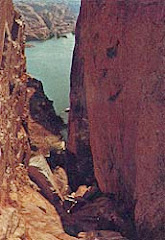
Hole in the Rock
They left in late October 1879, for the difficult journey through the Hole-in-the-Rock to Bluff. Their second daughter Ellen was born February 3, 1880. (The family believes she was born en route to Bluff, but historical accounts of the Hole-in-the-Rock do not include her as born on the way. Another date given for her date of birth is 1881, which would account for her not being listed as a Hole- in-the-Rock baby.)

Ute Indians lead by Chief Buckskin Charlie
Artist Unknown
Like the other Robb brothers, George did not stay long in Bluff, moving with some of his brothers to Mancos, Colorado. After only a year in Mancos, George and Cally decided to return to Paragonah, via the Old Spanish Trail. When they reached the Colorado River, it was a raging torrent. The ferryman refused to take them across because of the danger. George, “impatient as was his nature,” asked to use the boat. First, he filled it with his possessions and equipment and took it across the river. “I thought my arms would be torn from their sockets,” he recalled later. Exhausted, he wanted to rest before attempting the grueling return trip to get his family, but he was afraid for their safety. “Where I had left Cally and my little girls, there were Indians. I feared those Indians. I could recall the numerous times they had wanted to trade their blankets for my ‘redhaired papooses’.” So, without pausing to rest, he made the arduous return trip and brought his family across the river.

Before the family reached Paragonah, they ran out of provisions and lacked funds to buy more, so they had to stop at Price to earn money before continuing their journey. It was 1883, and the Denver and Rio Grande Railroad Company was extending its line through the Price River Canyon into Salt Lake City. George got work with the railroad, but when the job was completed, winter had set in. George and his family remained with the Henry John Mathis family until the following spring when they had decided to settle in Price.

That first year in Price, Cally gave birth to their first son on April 20, 1883, named George after his father. (Another of our frustrating discrepancies: one family group sheet lists George as having been born in Mancos, but there was no mention of a baby boy in the saga of how George got his family across the raging river, a strange omission if the infant were included.) In the spring of 1884, several families from Red Creek came to Price to make their homes, which probably contributed to the Robb’s’ decision to remain. Among the newcomers were Caroline’s sister and her husband. Without a “payroll industry,” times were often hard in Paragonah. Employment by the railroad in Price and other communities on the railroad line sustained many farmers and cattlemen during slow periods.

George bought a piece of land and built a small log house. He began to farm and over time purchased more land and a few cattle. His father William Robb gave him fifteen head of cattle to help him get started. More children came along: William (1885), Ada (1887), and Vesta (1890). George built furniture for their home. Their beds were great logs split in two and bound with rawhide strips, then covered with ticking stuffed with straw.

In the early 1890s, a diphtheria epidemic raged in Utah, and so many people died that the customary funeral services could not be held. Each morning, a great wagon went rumbling down the road on its awful mission of gathering the dead from the night before. If a white flag hung from the gatepost, the hearse stopped, picked up the loved one, and disposed of the remains. Eight-year old George had shown symptoms of the disease, so the other children stayed in the family’s granary under the care of 10 year-old Ellen. When the doctor came, he showed the worried parents the large white lumps in George’s throat. The boy was choking to death. The doctor attempted to remove the largest lump with crude surgery, but it was too late: young George died on June 27, 1891. That morning the white flag hung from the Robb’s’ gatepost.


George Robb
Son of Geo; Caroline Robb
Born April 20, 1883
Died June 27, 1891
More children came: Blanche (1892), Earl Pierre (1895), Arlin (1897). George and Cally figured the family was complete, but in 1905, Angus John was born. Cally was 45 and George was 49. Cally always said this child was born too late, yet he was a joy to his parents. “Lacking the vitality to go out and play with other children, he spent much of the time at home with his parents. He loved the farm and the animals and made them his life’s work.”

Angus J. Robb 1905-1945


Angus Robb Death Certificate

During the years the children were growing up, the family worked hard, but life was satisfying. They rose early in the morning. George fed and watered the horses and hitched them to the wagon. Only after Cally fed, watered and milked the cows and fed and watered the chickens did she turn her attention to preparing food for the family. The family finally assembled for morning prayer, said a blessing over the food, and sat down to a hearty breakfast. When breakfast was over, George and the older children took a generous lunch and a jug of water and set out for the field in the wagon. Caroline and the younger children cared for the livestock and bees, cleaned house and worked in the garden. In her “leisure” time, Caroline made clothes for the family, tended the sick and served as midwife for the community.

The entire family was active in the Church. When George had time and wasn’t busy with Church or his work, he earned extra cash hauling freight or passengers from Price to the Duchesne county or the Uinta Basin.

On Sunday afternoons, George relaxed by playing the reed organ in the family’s little parlor. “This towering instrument with its terraces of racks, carved panels and little shelves stood majestically at one end of the room. The tiny shelves held many candlesticks, and those candlesticks lovingly polished, gleamed in the lamplight. On the center table was a copy of the Bible, the Book of Mormon, a green plush album and a beautiful, handpainted lamp. It was a room that any man would be proud to gaze upon.”

Book of Mormon and Holy Bible
When Angus John was born, George at last decided to expand the size of the little house. The family lived on the west side while he worked on the east, then the other way around. As a crowning glory, he put in an upstairs. While shingling the roof, he slipped and fell to the ground, breaking his hip. For the rest of his life, he walked on crutches or hobbled about with the aid of a cane. Friends and neighbors completed the work on the house, but George never saw the upstairs he was so proud of. After many months of convalescence, he could again ride a horse, but work on the farm had to be done by the children, under his direction, and he had to sell most of the stock.

With the expansion of the railroad, many changes came to the state. Coalmines opened in Emery County and people flocked to the area to seek work. In1906, Emery County split in two; the north portion became Carbon County and Price was its county seat. The increased population, most of whom were not farmers, gave George a new market for his produce, and the sale of his cattle brought a good price. George bought shares when a bank opened in Price. Though his savings increased, George did not find a sense of security. The early years of poverty had been so difficult that George regarded himself as a poor man all his life. He gave generously to the Church, depriving himself to do so, and contributed money toward the new high school so his younger four children would not have to leave home for their education.

On April 22, 1922, Cally died of a heart condition, and “then George learned what poverty was really like, but it was a spiritual poverty. His children were kind, generous and helpful, but they could not replace a man’s mate and companion of 45 years. He lived in the old house alone for the next 20 years. During this time, it seemed for George as though time were standing still. A steady stream of grandchildren came along. His children took him to their homes for visits.”

Caroline Jones Robb Monument
Price City Cemetery Price Utah
George Drummond Robb died on October 10, 1942, at the age of 87. “He was thrifty and left an estate of just under $100,000 to be divided among his children,” a sizable fortune for that time. At the time of his death, he was survived by his five daughters (Mary Ann, Ellen Belle, Nellie, Ada, Vesta and Blanche) and three sons (William, Arlin and Angus), 21 grandchildren and nine greatgrandchildren.

George Drummond Robb Monument
Price City Cemetery Price Utah

George Drummond and Caroline Jones Robb
_________________________________________
Sources:


Zelia Pessetto, granddaughter of George Robb, in a story sent to the Daughters of Utah Pioneers. (January, 1958, “Lesson”)

Arlin Robb, family records and personal recollections, Max Robb, notes


Virginia Cook Hunter, daughter of Vesta Robb Cook and granddaughter of George D. Robb.