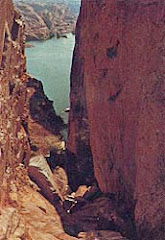
Walter Simmons Robb Family

Showing posts with label George Drummond Robb. Show all posts

Monday, September 12, 2011

Ann Elizabeth Robb - Pioneer Lady of 1857

Ann Elizabeth Robb Edwards

Birth: Jun. 27, 1846
Sydney, New South Wales, Australia
Death: Jun. 16, 1928
Paragonah, Iron County, Utah, USA

Ann Elizabeth was the daughter of Helen Bell and William Robb. She was the wife of William Edwards. Together they had nine children: William Robert Monroe, Sarah Ellen, Ann Caroline, David James, John Edward, Thomas Alexander, Morgan Bell, Horace Norman, and Nora Gladys.

Pioneer Lady of 1857 Passes Away At Paragonah

Mrs. Ann Robb Edwards of Paragonah, pioneer of 1857 to this city and one of the first white people to make her home in Paragonah, passed away at the family residence the first of last week and was buried on the 20th. Had she lived until today she would have been eighty two years old. She was born June 27th, 1846 at Sidney, Australia, from which place she emigrated at the age of eleven years with her parents after having become a member of the Latter Day Saints church. They were about four months in an old time sailing vessel crossing the ocean from Sidney to San Pedro, California, and though she was very young at the time she retained until her death a very vivid recollection of that voyage.

Arriving in San Pedro her father bought teams and wagons and the fmily made the trip to Utah, arriving her about December, 1857. Because of the menace of the savages at the time they made their home in the old fort where they lived for two or three years, being the first family to move out of the fort into a home of thier own. They experienced all the hardships incident to pioneer life in this locality. Her life was one of service to her family and to the community in which she lived, and at the time of her death was a faithful Latter Day Saint.

Her husband Wm. Edwards, proceeded her from this life by less than a year. She is survived by six sons, Wm. R., David J., John E., Thomas, Morgan and Horace, and one daughter, Mrs. Sarah E. Barton, all of Paragonah, together with twenty-four grandchildren, six great grandchildren, two brothers, Thomas Robb and George Robb, the latter of Price, Utah. All her children except Horace were at the funeral. He was in Montana and could not be reached in time to get here.

Speakers at the funeral were Simon A. Matheson of Parowan, Richard Robinson, Jr. of Los Angeles, Wm. P. Barton and Bishop Thomas W. Jones of Paragonah. Mrs. Richard N. Lund read a history of her life and musical numbers included a solo by L.J. Adams of Parowan, and songs by Unice Edwards Anderson and her little daughters of Los Angeles. (Mrs. Anderson is a daughter of Mr. and Mrs. David Edwards, former residents of Paragonah where she lived until she was three years old).

At the cemetery Mrs. Anderson and Amasa Stones, accompanied by the choir, sang "Lead Me Gentley Home". the grave was dedicated by Elder Amenzo Topham.

Parowan Times
6/27/1928

Ann Elizabeth Robb Edwards Death Certificate


Cemetery Marker for Ann Elizabeth Robb and William Edwards
Paragonah Cemetery, Paragonah, Utah

__________________________
Souces:
Ancestry.com
FindaGrave.com

Saturday, May 28, 2011

Answering the Call

Hole-in-the-Rock: When the wagons went
down this trail it was twice as long as it is today
Written by Georgia Robb Drake, grand-daughter to  Heber William Robb.

In studying the historical reports and diaries of the Hole in the Rock participates, as the time neared there was much excitement and anticipation for this new adventure to begin.  Throughout the summer of 1879, while emigration routes were being explored, families were rounding up livestock, disposing of property and acquiring sturdy wagons, necessary supplies and equipment.  "Ho for the San Juan" became a common greeting throughout Southern Utah.  Yes, I was concerned for those families, men, women, and children, full of faith, enthusiasm and courage, ready to take on an unparalleled expedition in untamed territory. Trusting scouts who were sent to determine the best route and feasibility of road building through the broken terrain returning with favorable reports, had done their job well. Trusting the land would be suitable for farming, trusting mostly in God.

A Utah newspaper described Utah's southeast corner in 1861, as "one vast continuity of waste and measurably valueless, except for nomadic purposes, hunting grounds for Indians and to hold the world together." The Mormons wanted to establish an outpost settlement to bring the word of God to the Indians and act as a neutral point of rendezvous of the southern Navajo tribes, and the war-like Ute and Paiute tribes to the north.  Many of those who inhabited this area did so by raiding and pillaging the Mormon settlements west of the Colorado. "One writer reported that at one time twelve hundred head of stolen cattle were driven across the Colorado at the Crossing of the Fathers. Losses to the raiders, in sheep, cattle, and horses, were estimated at more than one million dollars a year."This was such a harrowing experience, the accomplishment of those who went through the "Hole" is remembered with great respect. Then I wondered, would I have gone if I had been called? The answer is, Yes. I hope I would have the same faith and courage these brave pioneers showed, and retained under such adverse situations.


Great Grandmother Sarah P. Holyoak Robb worried about the outlaws who had made the difficult terrain their home. It is said that Solomon Wardell urged Sarah not to go on the expedition. Whether he did or not, Sarah, her husband Adam Franklin Robb and two sons, Albertus (4) and William Heber (2) were  among those daring pioneers of the San Juan Mission.  Adam's brothers George Drummond Robb and family, William and his family,  John and family were also among those called.  John also known as Jack and Thomas were driving a head of cattle to the San Juan. 


They were not just pioneers, before they left, each had been called on a mission.  The San Juan Mission. They were more than pioneers, they were missionaries with a call to colonize the four corners.  Among this incredible band, were two professional road builders.  They were paid $1.50 a day, very good wages for that time.  When they joined the group, the pioneers had already taken the wagons down the first huge obstacle, "The Hole".  Other equally daunting challenges lay ahead.  When they came to the next mammoth task, the paid road builders could not conceive of an answer to the challenges they had to overcome.  Overwhelmed, they finally gave up and went back to Salt Lake City, saying it couldn't be done.  Meanwhile, the Missionaries filled with faith in miracles and undying  determination faced those same obstacles together.  They solved their problems one after another until at long last, they reached their destination.  Starvation, freezing cold, hostile Indians, impossible feats of engineering and road building.  They faced them all with faith and courage, and proved their worth with every footstep.  

 I suspect the members of the San Juan Mission would tell anyone who questioned the wisdom of taking on such a harrowing journey, that their faith grew and miracles were experienced by all.  Today, anyone who looks at the extreme grade and narrow passage of the Hole in the Rock must do so with awe and wonder.  I am grateful my great grandparents were faithful in their role.  Not all stayed after they arrived, but none left without first receiving an official release from their mission call.  My grandfather William Heber Robb was only about 2 years old when he participated in this epic journey.

We Thank Thee Oh God
Hole-in-the-Rock

By David Miller

Appendix XI pp. 208

THE GEORGE B. HOBBS NARRATIVE

In Chapter VII of this work George B. Hobbs tells of the experiences of himself, George W. Sevy, Lemuel H. Redd, Sr., and George Morrell who were sent from the Hole-in-the-Rock to scout the country ahead in an attempt to locate a possible route all the way to Montezuma. The narrative found on the following pages is a continuation of Hobbs’ account in which he tells of his second expedition from the Colorado River to Montezuma, this time with provisions for the relief of the families which had been located there since the previous summer.

This account is copied from the San Juan Stake History, L.D.S. Church Historian’s Library.

After working some time on the road, which the company at the Hole-in-the-Rock were making by blasting, etc., down to the Colorado River, I returned to my camp at Fifty Mile Spring to get supplies and my mules in order to join Dan Harris on a return trip with supplies for our people who were starving at Fort Montezuma. Making inquiries from those who had promised to look after my mules while I had been away [on the exploring expedition] I discovered that they had neglected to keep their promise, and no one knew anything about my mules or where they were. Riders had been back as far as Escalante and had practically traveled all over the section of country lying between the Kaiparowitz Plateau and the Escalante Gulch, and no one had seen my mules since I had left. I started out to find them, going about 6 or 7 miles from camp. But finding no grass whatever I knew my animals would not stay in such a desert county. My belief was that they would try to make for their former home in Parowan. Returning to camp with this belief, I decided the next day that I would quit the camp altogether as I did not like the way the brethren had treated me in this matter, while I had been exposing my life to explore the road for them.

Therefore, I set out alone early one morning, in February [January] 1880 with a supply of crackers and my blankets with the intention of returning to my home. After going a mile or so I was impressed to lay my griefs before my God and kneeling on a smooth rock I uttered a few words of prayer, asking God to direct me in what I should do. The impression came to me that I should keep to the west side of all horse tracks. This I did, and after traveling a short distance I found some tracks leading up the steep barren clay hills toward the Kaiparowitz Plateau Cliff. I followed the tracks almost to the cliff where I found a narrow bench covered with abundant bunch grass, and here were my mules, fat as they could be, together with one other animal which the company had thought dead. This happy discovery came, as I always believed, as a direct answer to my prayer. Once before, when on my first trip, my prayers had been answered in a similar way, when I besought God to direct me which way to go, we having lost our bearings. He answered it by impressing me that I should follow the canyon to a certain place where I found a large cottonwood growing. This I did and found it was the only way we could get out. This simply meant the saving of our lives as we were starving, being without food in the cold snow, after having lost our trail.

Dan Harris returned from Escalante with supplies, and as it had been prearranged that I should return with him to bring supplies to those at Montezuma, we traveled together to the Hole-in-the-Rock near the Colorado River and then crossed the river, I fording the river with my horses, his horse being already on the other side. Taking our supplies in a boat, we camped about three miles on the east side of the river the first night. A heavy snow storm overtook us, and as the indications were that it would continue I refused to go further until the snow abated, starting it was better to have the snow under feet than over head. Bro. Harris became quite angry at my suggestion to stay a day or so and went [pp 210] back to the river where he persuaded two California miners (father and son) who were with the party to accompany him.(1)

Some of the brethren had gone about four miles further ahead to work on the road in order to make it easier for us to get out with our pack animals. When Bro. Harris passed these men they asked where I was. He answered that I had refused to start in the snow storm, and he was glad of it, as I wanted to go by way of the Elk Mountain, and he knew he could go up the San Juan. He then said, “Tell Hobbs that I will meet him on the road.” It pleased the brethren to think that a shorter way might be found, as I had held to my opinion that my way was the only way to get through.

I now stayed and worked on the road three weeks longer as I wished to get my wagons across the river. (2) The storm continued most of the time. When I got ready to start I asked for a volunteer to go with me but none would go. Bro. Sevy said no man could live and go through those cedars with the snow which must be on the ground. I said that I would go, as I would never live to know that women and children were starving to death for the want of an effort on my part.

The next morning I placed the packs on my mules, tying the head of one to the tail of the other and leading the first one. In this way I traveled the entire distance, going on foot myself. The second day, when I cam to the slick rocks, I looked back and saw a band of horses following me with men driving them. When they reached me at the bottom of the rocks I found it was Jack and Adam Robb, formerly of Paragonah.(3) They told me they were going to leave their horses at the Lake and accompany me through, as they had been off their homesteads near Farmington, New Mexico, for six months and were afraid someone might jump their claims.

We made good time, following the back bone or dividing ridge between the Colorado and San Juan Rivers toward the Elk Mountains, the snow getting deeper every mile we traveled. The weather was so cold that the snow was not crusted. Five days I spent in these cedars and gulches with the snow up to my chin. I had to cut trees out of my way in order to get through and my mules did not have a mouthful of food during this time. On Feb. 22nd, 1880 (my 24th birthday), I got out of this deep snow into a branch of the Comb Wash where the ground was bare. Here my mules would eat a little grass and then roll in the sand, which seemed to give them much pleasure, after being in the snow so long. The next day was good traveling down the Comb Wash.

Passing the Harris camp (4) the following day I reached Montezuma. Geo. Harris road out overtaking me, (5) asking me how long I had been on the road. I answered that this was my ninth day. He said, “You have made good time.” I asked him when Dan Harris had got through. He said “Yesterday,” and explained that he and his companions had eaten up all his supplies. He had been wandering in the deep snow 29 days (6) from our camp in the Hole-in-the-Rock. Geo. Harris desired to buy some of my supplies but I stated that no money on [pp. 211] earth could buy them, as they were sent to relieve those who were starving at Montezuma.

George and his brother Dan immediately got ready to return on my tracks to the main camp, which they did, reaching the camp at Cheese Ranch, about 10 miles east of the Colorado River. Inquiries were made as to whether they had seen me. They answered, “Yes, he got through, and for God’s sake if there are any of the rest of you that want to get through, you had better follow his tracks!”

It was a joyous moment for those starving Montezuma people when they saw me coming over the hill with the white sacks of flour on the packs. They had been watching for nearly a week, as the 60 days of promise were just expiring (my companions having on our first trip stated we would return with food in 60 days, they believing they could hold out that long).(7) They had but one pint of wheat left when I arrived and had not tasted flour for over four months. I stayed with these people 20 days while the Robb boys went up to Farmington and worked on their homesteads. Upon their return I joined them.

Just previous to our return a cowboy carrier [courier] had brought word to Montezuma Fort that the White River massacre (in which the Meeker family were massacred by Indians) had occurred and for us to be on the lookout as well as those at the fort.(8) Before leaving the camp at Cheese Ranch I had agreed upon a system of signals on any prominent ridge that I might cross to guide the company which way to come, my signals were three fires in a triangle. On the third way out we were making toward the Elk Mountains, arriving at a prominent ridge about noon. I made my first signals, which were immediately answered by a signal fire on the side of Elk Mountain. We were pleased to think that we would be with company again that night. No sooner had we started towads their fire in the afternoon and gone down into a box canyon than we came across the fresh trail of the Indians fleeing into the country west of the Elk Mountains. They had passed but an hour or so before. Not knowing whether the fire we had seen was an Indian’s signal fire or our friends, made our going dangerous, as we expected to be shot from every turn in the trail, my companions preferred that I go in the lead, they keeping well behind. I still had confidence in my God that he would preserve us, as he had done before. We found by the sign which the Indians’ horses had left that we were gaining on them as it made traveling for us much better than for them as they beat down the snowdrifts.

These Indians ran into our brethren’s camp about an hour ahead of us, retreating into the hills immediately not knowing but what our people were hostile toward them. They sent a squaw in, and our people gave her some clothes and food. Then others ventured in, they asked about us, but the Indians said they did not know anything of our whereabouts, although we were behind them. The men immediately came to the conclusion that they had killed us as they seemed so ignorant of our whereabouts. Six men immediately started out back on their trail expecting to find our dead bodies. They met us about half a mile from their camp. I then told them of the Meeker massacre and that perhaps [pp. 212] these were the Indians that were getting away. They immediately threw out guards to protect the camp and stock.

They had agreed to bring my wagon with them, but I learned it was where I had left it. This necessitated me going back after it. I met many different parties that were on their way to catch up with the main camp which was now at the Elk Mountain. The weaker ones were in the rear, some had an ox and a mule hitched together, some had cows and heifers in their teams, one I noticed was a pair of mules with an ox on the pike with a young girl riding the ox, to keep him in the road, all made inquiries of me how far it was to San Juan. The Robb boys accompanied me back as far as the Lakes staying there four days while I returned alone to Cheese Ranch for my wagon. In places where I could not get up the hills with my load wagon (having no help) I packed the supplies from my wagon onto pack mules, then came back for the wagon.

On April 4th, 1880, we overtook the main company at a place now called Rhen Cone on the San Juan River. (9) Next day we pulled up a steep dug way that had just been completed, (10) and the following day (April 6th 1880) we arrived at the point on the San Juan where Bluff City now stands. Much disappointment was experienced by members of the company of about 225 souls on their arrival for they had expected to find a large open valley, instead they found a narrow canyon with small patches of land on each side of the river. Wm. Hutchings of Beaver was the man that named the place Bluff City on account of the bluffs near by.(11)

The next day (leaving camp here) I pulled up to Ft. Montezuma which was my destination. The company now began the general work of colonizing, taking out the water, building water wheels, putting in crops, etc. I had promised Silas S. Smith who was captain of our company who was home at Paragoonah that I would let him know when the company got through, I just had time to scribble a letter to him sending it to Mancos (125 miles away) by a cowboy who was just leaving, to that effect, this being the first news to get back to Utah of the company getting through.(12)

Footnotes

1- Hobbs, and Harris had camped on Cottonwood Creek when the storm struck. These California miners are mentioned in numerous accounts but are never given further identification.

2- During this time Hobbs did get his outfit across the river, probably coming across with the rest of the wagons from Fifty-mile camp late in January 1880. He took his wagon as far as Cheese Camp before finally setting out with packs for Montezuma, as is “indicated by later references in this account. Although Hobbs uses the plural, “wagons” in this one place, it seems quote obvious that he had but one.

3- Platte D. Lyman’s journal entry for February 15, states that four men started for the San Juan with pack animals that day. This number probably included Hobbs, and the Robbs. This checks about right with later statements by Hobbs, that he arrived at Comb Wash on February 22 and at Montezuma two or three days later, having traveled 9 days from Cheese Camp. James Dunton and Amasa Barton had also taken a herd of horses ahead of the main company from Cheese Camp, according to the Lyman record.

4- At the site of Bluff.

5- George Harris rode out of the Harris camp at Bluff and overtood Hobbs as he was passing by on his way to Montezuma.

6- Hobbs had spent nine days, having left Cheese Camp February 15. He and Dan Harris had originally crossed the Colorado to begin their trip together about January 23 or 24.

7- In his Desert News (December 29, 1919) account Hobbs says: “I having on my first trip stated I would return with food in 60 days.”

8- For an account of this massacre see LeRoy R. Hafen (ed), Colorado and its People, I, 381-86 It is hardly likely that the Indians Hobbs followed into camp three days later were members of the Meeker Massacre party.

9- Rhen Cone! -- bend or corner. This is where the San Juan cuts through Comb Ridge. It is the site of the later Barton trading post where Amasa Barton was killed by an Indian a few years later.

10- San Juan Hill.

11- As far as I have been able to learn, this is the thinly account that gives William Hutchings credit for having suggested the name of Bluff City. I see no reason to doubt it. When the U.S. Post Office Department was preparing to establish an office there, the name was shortened to Bluff.

12- In his Desert News account, Hobbs states: “My father, who lived at Parowan, had promised Silas Smith, who was still at his home in Paragonah … that he would let him know when he got a letter from me saying the company got through…”

APPENDIX I
HOLE-IN-THE-ROCK PERSONNEL

B. Personnel Of The Hole-IN-The-Rock Expedition:

Gurr, William Heber (Parowan) Family Friends traveled to U.S. on Ship Lucas w/Robbs
Anna Hanson
  William John

Holyoak, Henry (Paragonah) [Sarah Permelia’s Uncle]
Sarah Ann Robinson
  Alice Jane
  Henry John
  Mary Luella
  Eliza Ellen
  Albert Daniel

Robb, Adam Franklin (Paragonah)
Sarah P. Holyoak
  Albertus
  William Heber

Robb, George (Paragonah)
Sarah Ann Edwards
  Ellen Jane
  Sarah Ann

Robb, William (Paragonah)
Ellen Stones
  William

C. Persons Sometimes Listed As Among The Hole-In-The-Rock Company But Without Definite Proof:

Robb, Alexander
Robb, Samuel (Son of William Robb and Susannah Drummond)
Robb, Thomas

Thursday, February 3, 2011

Hole-in-the-Rock - Liahona Aug. 1996

Hole-in-the-Rock
By LaRene Porter Gaunt


LaRene Porter Gaunt, "Hole-in-the-Rock", Liahona, Aug. 1996, 21
The faith, courage, and sacrifice of the Saints who passed through Hole-in-the-Rock in 1880 stand as an example to all Latter-day Saints of the power available to us when we are on the Lord’s errand.

“Should we turn back or move ahead?” This was the question that dominated the thoughts of the pioneer company on the night of 3 December 1879. Church President John Taylor had called this group of pioneers to settle the San Juan Mission, in the southeastern part of what is now the state of Utah. But at this point in the trek, there seemed to be no clear answer on how to proceed.

The pioneers were camped at 40-Mile Spring, located on a high plateau. Silas S. Smith, the president of the company, realized how serious their situation was. Camped in some 80 wagons were nearly 250 men, women, and children. Hundreds of cattle were also part of the caravan. Winter was upon them, and they had too few supplies and other resources to remain at this encampment until spring.

President Smith sat in his tent and deliberated with other leaders. Turning back seemed impossible. Behind them, to the west, heavy snows had buried the road through the Escalante Mountains, as well as any foliage the livestock could eat. Besides, the pioneers took seriously the calling President Taylor had given them to settle the San Juan Mission, which was part of President Brigham Young’s original plan to establish settlements throughout much of the West. Who among them would refuse such a call?


Modern view of one chute
Most felt it was impossible. After much discussion, one of the men made the motion to leave the decision to “President Smith and the Lord.” 1 A unanimous vote reflected the faith of those present that the Lord would inspire their leader.Ahead of the pioneers, to the east, lay more than 300 kilometers of rough terrain with no road and little water. A decision to go forward would force them to travel through Hole-in-the-Rock—a crevice in the west wall of Glen Canyon at a high plateau above the Colorado River. It was a dangerous shortcut, but the only other trail was more than 600 kilometers long. An exploring party’s report had been pessimistic. Going through Hole-in-the-Rock would mean taking wagons and cattle on a trail that dropped 610 meters, one-third of that drop at a 45-degree angle.

Old and New tracks
The next morning, President Smith called a meeting to announce the decision to move ahead. “The miracle of this decision went through the company like an electric shock,” wrote Kumen Jones, a member of the group, “and all was good cheer and hustle.” In the meeting, many bore testimony in support of moving ahead. Someone began to sing. Others joined in, and soon the chilly December air rang with “The Spirit of God like a fire is burning!” (Hymns, 1985, number 2).

(click to view larger)

“We Did Make Dirt and Rock Fly”

United in their resolve to be true to their call from the prophet, the company headed into the desert toward 50-Mile Spring. Since there was no road, the pioneers cut their own through what one man described as “the roughest country I ever saw a wagon go over.” Mostly rock and nearly void of foliage, the land was a combination of gulches and straight-walled chasms more than 100 meters deep.

At 50-Mile Spring, President Smith divided the company into three work groups: one to work at the crevice, one to build a road from the crevice to the river 1.2 kilometers away, and one to build a ferry. For the next six weeks, all three groups worked simultaneously. “I don’t think I ever [saw] … men go to work with more of a will to do something than that crowd did,” wrote Cornelius I. Decker of the group who worked to widen the narrow crevice. “We were all young men; … we did make dirt and rock fly.” Two blacksmith forges were established at “the Hole” so that blacksmiths could keep tools sharp as men cut solid rock. Several men were lowered by rope in half-barrels over the 14-meter cliff. While dangling in midair, they drilled holes in the cliff and filled them with blasting powder. Work continued in snow storms as well as in sunshine.


Horse hoof toe holds
The second group constructed a road over virtually impassable land. The steep upper third of the road was a serious challenge; among the problems the workers had to solve was how to create a section of road along the face of a 15-meter rock wall. First they blasted a ledge along the wall, then extended the ledge outward. This was done by hammering staves into holes drilled parallel to the ledge. Logs, rocks, and gravel were piled into the resulting area to build up a shelf just wide enough to accommodate a wagon.

The third group built a ferry wide enough to carry two wagons at a time across the Colorado River. Part of this group also began work on a road eastward.
"We Thank Thee Oh God"


“I’ll Never Forget that Day”

On 26 January 1880, everything was ready.

Elizabeth M. Decker wrote of the first wagons to go down through “the Hole”: “Coming down the hole in the rock to get to the river … is almost strait down, the cliffs on each side are five hundred ft. [about 155 meters] high and there is just room enough for a wagon to go down. It nearly scared me to death. The first wagon I saw go down they put the brake on and … [chained the rear wheels together so they slid as a unit instead of rolled] and had a big rope fastened to the wagon and about ten men holding back on it and they went down like they would smash everything. I’ll never forget that day.”

When the wagons went down this trail it was twice as long as it it is today.
The surface of Lake Powell has reached its permanent level at 4,000 feet.

The wagon of Joseph Stanford Smith was the last of 26 wagons to pass through Hole-in-the-Rock that day. Brother Smith, known as Stanford, had helped others all day while his wife and three children sat on a pile of quilts in the snow and watched. Apparently not realizing that men would be coming to help them, Stanford and his wife, Belle, thought they were stranded. So they determined to bring their wagon down by themselves. Belle sat their three-year-old son on the quilts, placed the baby between his legs, and told them not to move until their father came back for them. Ada, the oldest, sat in front of her brothers and said a prayer.

Belle and one of the horses pulled on the ropes tied to the back of the wagon as Stanford braced his legs against the dashboard and gently urged the lead horses on. As soon as they started down, the anchor horse fell. Belle caught her foot in the rocks and broke free several times before she too fell and was dragged along with the horse down the steep slope. By the time the wagon stopped, a jagged rock had torn into Belle’s leg from heel to hip. Stanford ran to her to see if she was all right. With pioneer tenacity, Belle told him she had “crow-hopped” all the way down. Stanford helped her into the wagon, cleaned her cut, and then climbed back up for the children. As he passed his horse, which was dazed but alive, Stanford took off his hat and waved it in the air as a salute to his wife. They had made it!

“Hustle and Harmony”

After crossing the Colorado River by ferry, the company still faced more than 240 kilometers of rugged ground. Elizabeth M. Decker described this land in a letter to her parents. “It’s the roughest country you or anybody else ever seen; it’s nothing in the world but rocks and holes, hills, and hollows. The mountains are just one solid rock as smooth as an apple.” Because the land turned out to be rougher than anticipated, the journey took much longer than expected—six months instead of six weeks—making the so-called shortcut extremely arduous. Two babies were born along the way. Supplies had to be brought in to the company by mule train. On 6 April 1880, the exhausted company came upon a few acres of good farmland near a small river. They named the spot Bluff City.

Though travel worn, the pioneers had remained true to their resolve to follow the prophet and move forward, and they had endured the hardships in good spirits. As one member of the company recalled, “In a camp … moving … through extremely rough country, one would naturally look for some trouble and a few accidents, but this was not the case. All was hustle and harmony.”

The road created by this pioneer company served as the major highway in and out of the area for about one year. Westward traffic heading back up the steep corridor through Hole-in-the-Rock required each wagon to have a six-horse team.

By 1882 the road had fallen into disuse, but the pioneers had done what they had set out to do—establish a settlement in a remote area of the proposed state of Deseret. Though the area today remains somewhat isolated, it stands as a legacy of those faithful and tenacious pioneers who cut their way through solid rock in obedience to a prophet’s call.

Note:  David E. Miller, Hole-in-the-Rock (Salt Lake City: University of Utah Press, 1966), page 65. Miller’s book was the source for much of the information in this article.
______________________________________
Source:  http://lds.org/liahona/1996/08/hole-in-the-rock?lang=eng
Photos

Friday, January 28, 2011

William Robb and Ellen Bell and Susannah Drummond

Helen or Ellen Bell Robb
Ellen Bell was born in Perth, Scotland, on June 30, 1819, the daughter of Margaret Monroe and William Bell, and the granddaughter of Isabella McLaughlin and Robert Monroe and Helen Normand and William Bell. (She was christened “Helen” Bell, and that is what is on her gravestone; however, she is referred to by the family as Ellen, and that is how we shall refer to her in this history.”

William Robb, born on January 15, 1815, in Caas of Cowry, Scotland, was the son of James Robb, a well-to-do farmer who was killed by the kick of a horse, and Christian Ewan Robb, who lived to be 100 and was buried in Kendoul Churchyard in Scotland.

Kendoul Churchyard
James Robb  and Christian Ewan Robb his Spouse
James Robb who died at Barnhill
Also, in memory of their son John who died 1 May 1830 age 20  

After William (22) and Ellen (18) were married on August 23, 1837, William bought a coach making and repair shop with his savings and part of her dowry, and in this shop he plied his trade. A family story has it that he first repaired and painted coaches for Queen Victoria and later actually built them.

The class structure in the United Kingdom was very rigid. Upon the death of the elder Robb (date unknown to us) William’s older brother Thomas was appointed by King William IV as “Squire of Bramblebury.” Thomas was suddenly important, and since he was now richer and in a higher class than William, he did not speak to him again, although, given William’s famous temper, there may have been additional reasons for the rift. Brother James, also richer than William, remained on friendly terms with him. Sisters Belle and Jane, both of whom married lower-class men, stayed on friendly terms with William and James, possibly Thomas as well.


Shortly after the birth of Ellen and William’s first child, James (September 12, 1838), William decided to take advantage of the government’s offer of free land in Australia, in the area known as New South Wales, for “free settlers and convicts.” Things were not going as well as William wished, and his quick temper also caused problems in his profession: once, in the throes of anger, he threw a wrench through the dashboard of a coach and had to rebuild it. 
New South Wales
William sold his business, invested the capital in hardware and household goods, and, along with his brother, James, prepared to move his family across the seas. It was hard for Ellen to leave her family, to whom she was devoted, and although they corresponded, she was never to see them again.

The sailing ship to Australia took eight months. It was a difficult voyage, being delayed by a fierce storm and the resulting shipwreck at the Cape of Good Hope on the tip of Africa. Relatives in Scotland were greatly grieved by the first message that all hands on board had been lost in the disaster, and they were much relieved when the correct news came through at last.

Once in Sydney, the Robbs’ fortunes improved. William was given a tract of land by the government and provided with convict labor to improve it. At the same time, he and Ellen set up adjacent stores, William managing one which traded in tools, coaching building and hardware, and Ellen trading in dishes and household goods in the other. Listed in the 1847 Sydney directory is William Robb, Coachbuilder, 325 George Street, with the stores listed at 397 and 399 George Street.

The family flourished in Australia. Business grew as did the family: William Jr. (1841); Albert (1843); Ellen Matilda (1844); Ann (1846); Thomas (1848); John (1850); Alexander (1852); and Adam (1853).

In 1850, the year that John was born, James, then 12, was having trouble in school, being unable to get along with the other boys and engaging in numerous fights. In an effort to discipline him, William gave him several “licking’s.” While the family blamed inadequate medical care for his failure to recover, Williams always regretted he had been so severe, because James died shortly thereafter.

William did have his violent and temperamental side, but he also had a kind and caring side. After he and Ellen converted to the Mormon Church, their home was always open to missionaries and other Mormons, and at one time it was the district headquarters for the Church. Once a young missionary fell ill, and the Robbs cared for him in their home until he died. Because his body could not be shipped home, William paid all the expenses for his burial in Australia. He also financed the way for many needy friends to go to Utah while he and Ellen made their plans to emigrate.

Ellen was not only the loving mother of seven (surviving) children: she was also a successful businesswoman. She sent the money she earned from her store - which also carried luxury chinaware - to Utah by returning missionaries as a loan to the Church. There is no record that these funds ($6,000) were ever returned to her or her family.

In 1855, the family story took a different shift. Sixteen year old Susannah Drummond took a job as a clerk in William’s store. A lovely girl with dark hair and blue eyes, she enjoyed the acquaintance of William Robb Jr., two years younger than she. The romance was short lived, however, since William, Sr. forbade his son to visit her again. In fact, when he found his son “sparking” Susannah, he thrashed him soundly...  in spite of Ellen’s pleas for mercy. William, evidently furious at his son’s interest in a girl he wanted, upset his son to the point that William, Jr. left home, vowing never to return. Susannah moved into the Robb household as a domestic. William Sr.’s interest in her grew.

That same year, 1855, Ellen gave birth to another son, whom William named George Drummond Robb after Susannah’s father. One can imagine Ellen’s reaction to all this.

Susannah’s father was the son of an English gentleman, while her mother, Susannah Jenkins, was the pretty daughter of a gardener or farmer. One day when George Drummond was out hunting, he met Susannah and they fell in love at first sight, marrying in 1835 against the wishes of his family. They made their home near her parents.

The first years of their married life were happy. A daughter, Sarah, was born in 1839 when George left on what was to be a short business trip. He never returned. As the weeks stretched into months, Susannah gave up all hope of ever seeing her husband again. When her daughter, whom she named Susannah, was born on November 13, 1839, Susannah Drummond had neither the strength nor the desire to live. She died soon after and was buried in Bath.

After their mother’s death, the two little girls were taken in by Susannah’s cousin, William Hawkins, and his wife, Eliza, who were childless. The children called them “Aunty and Uncle Hawkins.” The Hawkins couple decided to take the girls to Australia because they were afraid the Drummond family might try to claim them.

At the time Susannah moved in with the Robb family, the doctrine of polygamy was becoming more widely known and was taught to the faithful in Australia as well as other places around the world. Since Susannah’s guardians, Aunty and Uncle Hawkins, had joined the Church along with Susannah, they were neither surprised nor dismayed when William asked Susannah to be his polygamous wife. She consented, and although William had been married to Ellen for twenty years, was 42 years old, and had fathered ten children, he married eighteen-year old Susannah in 1857, a Mormon missionary presiding. Certainly, the marriage had no standing under British law.

William’s children were aghast. Until this time, William and Ellen had had a close relationship, working together at home and at the shops, planning together for their eventual trip to Zion. Already upset with their father for the death of James and the thrashing and alienation of William, Jr., the older children were further troubled by this marriage to a young girl which was so distressing to their mother. When Ellen protested against the marriage, ...she threatened to leave him and go by herself to Utah, where she felt her money on loan to the Church would provide for her family. At that, William decided to go there immediately with the family.

William sold the businesses for a reported $50,000  and the family bought clothes, food, seed and all other necessary goods for their new home. They bade goodbye to William’s brother James, his family, and other friends in Sydney, and on June 27, 1857, they left on the sailing ship, “Lucas,” Captain J.C. Dagget in command.

Susannah’s sister Sarah had married a sailor named Richard Rillstone, who signed onto the “Lucas” as one of the crew, which paid for his passage over. Aunty and Uncle Hawkins also came along, and William paid the fare for several returning missionaries as well.

In the Robb party in addition to William, Sr., were Susannah, then three months pregnant, and the gallant Ellen and her eight surviving children: William, Jr. (16); Ellen (13); Ann (11); Thomas (9); John (7); Alexander (5); Adam (4); and baby George (2). Certainly, Ellen had her hands full, especially considering that her husband was in thrall over his pregnant teen-aged bride.

Because of bad weather, it took 108 days (over three and a half months) to cross the Pacific Ocean, and many of the passengers were sick all they way. When the ship docked in San Pedro, California, on October 12, 1857, Susannah said goodbye to Sarah, from whom she had never before been separated. Since Richard was a member of the crew, he had to complete the entire voyage, which meant traveling on to Oregon. From there, he and Sarah - and new baby William Wall Rillstone, who had been born September 22 on board ship - expected to go to Utah to join the Robbs. They never made it, and were never heard from again. Susannah wrote letters to California, Oregon, Australia and even to Scotland in her desperate efforts to trace her sister, but she never found her, finally concluding that the Rillstones had lost their lives at sea or at the hands of Indians. This loss was a lifelong tragedy for Susannah, who waited and waited for that longed for reunion.

Once in San Pedro, William loaded the family possessions, which included a considerable sum of gold placed into packs, into a hired wagon and took the family to San Bernadino. Ellen and William stayed with a doctor friend from Australia while final preparations were made to cross the desert to Utah. Susannah remained with the Hawkins in a camp near the edge of town so she would not be discovered as a polygamous wife.

San Bernadino had been established in 1851 as an important link on the journey from San Pedro to Salt Lake City. About a month before the Robbs’ arrival there, the Mountain Meadows Massacre (in which the Fancher party on their way west were cruelly murdered by a group of Mormons) caused such anti-Mormon sentiment that Mormons in outlying areas were called home to Salt Lake. Some 90% of the three thousand Mormons then living in San Bernadino packed up their belongings, sold their holdings - usually at a loss, if they could find buyers at all - and made the long journey back to Salt Lake. The Robbs arrived there in the midst of all this turmoil and at a time when many Mormons had already departed.

Shortly after the Robbs arrived in San Bernadino, an angry mob gathered in the area and threatened to tar and feather the newly arrived group. The Robb’s friend, the respected doctor, stepped out his front door with his gun and told the mob that these new arrivals were his friends, “that they had been on the high seas when the massacre was committed, and that they could not possibly have had anything to do with it. If you (the mob) want to come into my home to take them, it will be over my dead body.” The mob dispersed, but the travelers didn’t know how much longer they would be safe, so they made immediate preparations to move on.

When the sun greeted them the next morning, they already had a good start, and by the time they camped that night and were finally able to rest, they were all physically and mentally exhausted.

Along the way, the company was ever watchful for wild beasts, hostile Indians, and threatening anti-Mormon gangs, standing a guard every night as a precaution. They did meet many Indians, but none seemed especially hostile. The pioneers treated the Indians in a kindly fashion, giving them food and clothing. At one camp, the immigrants cooked a huge pot of cornmeal mush, and shared it with the Indians. The children were greatly amused to see the Indians try to eat this soft food with their fingers. The Indians refused to use spoons, which were offered, and even scorned the use of cups and bowls. Only if there were too many to gather directly around the pot would they accept these smaller containers.

While camped on the Mojave Desert near the Colorado River, Susannah gave birth to her first child, a little boy she named Mojave. She was delighted, as she loved the baby dearly and felt she had a family of her own at last.

The first white men the travelers met on their journey were some missionaries in Santa Clara, Utah, a tiny place on the Utah - Nevada border just a bit north of Arizona. Under the leadership of Joseph Hamlin, the missionaries were trying to become friendly with the Indians and teach them to farm.

The party traveled on. Baby Mojave was sick, and on Christmas Day at Cedar Fort (now Cedar City), he died. Susannah was heartbroken to lay her baby away in the desert land so far from home.

One week later, they reached Paragonah. It was New Year’s Day, 1858. The six-week journey from San Bernadino to Paragonah had been a continuing nightmare for Susannah, suffering through the final weeks of pregnancy, then childbirth, nursing her sick baby, and finally watching him die and burying him. No doubt, she wished she had her sister to comfort her. The whole trip from Sydney to Paragonah had taken over six months.

In 1857, Paragonah was a small Mormon community in Iron County, Utah, some 24 miles north of Cedar Fort. Residents of Parowan, about four miles southwest of Paragonah, had assembled this new village a few years earlier, but because of Indian problems, permanent homes in Paragonah were put off. A fort was laid out and completed in 1855. Made of adobes, it was 100 feet square and two stories in height. The lower walls were three feet thick and the upper walls were two feet thick. There was only one entrance to the fort and no outside windows were placed in the lower story, though several were inserted in the upper story to serve as observation points as well as for light.

The newly arrived group from Paragonah moved into the fort, as Indians were still troublesome. The dwelling houses were connected with the outside wall of the fort, but extended all around the fort facing the center. Each family was given rooms according to the number of family members, and the northeast corner was a large room which served as church, school house and amusement hall.

On November 4, 1858, Susannah’s second child, Samuel, was born and he was to be her only surviving son. Ellen gave birth to her last child, Carrie, on July 19, 1859, but Carrie died shortly after birth.

Life in the Paragonah Fort was simple, but there were periodic diversions. Thursday evenings, there were prayer meetings. On other days, there were spelling bees, and the women had spinning bees where they made raw wool into yarn to be woven into cloth. They took turns holding these bees in each other’s homes, and were rewarded with supper.

Each family had a few milk cows which were herded and guarded on the meadows by the men, while the women were given turns to use the milk to provide butter and cheese for their families.

[Once, on the Fourth of July, it was Mary Prothero’s turn to make cheese. The Protheros were from Wales and were relatives of the Edwards family; they were also among the first and most prominent residents of Paragonah. Mary’s daughter, Susie, had a new pair of shoes, but her mother lent them to another girl to wear to the celebration since they wouldn’t be going. When the cheese was in the press, however, a neighbor invited the Protheros to go to the dance with them. Susie was nearly in tears as she sat at the dance, trying to keep her bare feet covered while her new shoes danced gaily over the floor on the other girl’s feet. From Ilene Kingsbury’s Paragonah Patrols.]

In fact, the community was as united as one big family in their work. The men, when going to the canyons for firewood, went in companies or squads of six or eight. This was a time of suspense, lest their stock or crops be destroyed, and preparations were always considered for attacks which might be made by Indians.

Eventually, a corral was built just north of the fort, it too having high walls for protection, and the men took turns guarding the stock in the corral at night and on the meadows by day. The fort was considered one of the strongest and safest forts in the area, and was occupied until 1862. In 1860, a town site was measured off, and by 1862, new homes were being built and people were leaving the fort.

William Robb is said to have built both Ellen and Susannah a log house, which stood side by side on the property east of and across the road from the fort, on the south corner of the northeast block. The date was probably about 1861.

Some family writers have suggested that Susannah and Ellen “became good friends” during this time because they shared “the hardships of pioneer life.” There is, however, considerable evidence of bitterness on the side of Ellen’s children so this “friendliness’ is somewhat unlikely.

Not long after his arrival in Paragonah, William was summoned to Salt Lake by Brigham who had learned of the “fortune” in gold coins that William had brought from Australia. Brigham persuaded William to make a large loan to the Church for the purpose of financing wagon trains from Missouri. (The ill-fated handcart companies convinced Brigham that needy converts needed more assistance, and the practice had started of sending fully-equipped wagon trains out from Utah to meet the pioneers at the Missouri River.) A dispute as to whether the funds exchanged were a loan or a gift eventually led to a serious breach between William and the Church.

1861 was to prove an eventful year. On April 15, Susannah gave birth to her first daughter, Isabelle, who was known as “Baby Bell.” Then, in October, during the Conference, Brigham called William Robb, among others, to go to the Cotton Mission to Washington County, in order to help settle Utah’s Dixie. It was Brigham’s hope to make the entire Mormon country self-sufficient, and he was optimistic that the climate and soil in Dixie would be good for growing cotton.

At first, William was reluctant, because he liked the life in Paragonah and had seen the small rocky valley he was being sent to, the many hills and sparse vegetation, except for greasewood and cactus. The decision was a hard one. Some family accounts say the decision was reached by “family discussion.” According to William, Jr., his father “deserted Ellen as they were not getting along well since the polygamous marriage.” No doubt, the lack of harmony between his two families, his obvious preference for his younger wife, and his desire to follow the dictates of the Church were all factors leading him to decide to go.

 It was then decided that William and Susannah and their two children would go to Harrisburg, a village in the Dixie area, while Ellen and her eight children would remain behind in Paragonah. William Jr., also called Bill, was put in charge of the farm and cattle, with the aid of his younger brothers: Thomas (14); John (12); Alex (10); Adam (9); and George (7). Ellen and her daughters, Ellen (18) and Ann (16) had many tasks of their own. They sheared the sheep, then spun wool into yarn which they then wove into cloth for the family clothing. The vegetable garden provided food and livestock yielded milk for butter and cheese. During the summer, the family lived down on the meadow in a log house so they could more readily look after the cattle, taking the excess cheese and butter to Salt Lake to be sold or traded for things not easily available in a small town.

Some time after 1864, Ellen had a big brick house built for her family, hiring the Spillsbury boys from Toqueville to build it. It was one of the first brick houses in Paragonah. Two stories high, it had four large rooms, each with its own fireplace, and was still standing in 1967, when JTW III and June visited the area.
Helen Bell Robb Home
Paragonah, Utah
Ellen was very proud of the beautiful dishes she brought from Australia and had a special cupboard built to display them. The townspeople, men as well as women, called on her to admire them. Since there was not occasion in Paragonah for Ellen and her daughters to wear the silk and satin brocaded clothes they brought with them, they sold them to the women in town to be made into fancy hats. The Robb women were content to wear homespun dresses and knit stockings, just like the other pioneer women of the day.

1864, the Edwards family arrived in Paragonah from Wales and the two families got acquainted. Both Sarah Edwards and Ellen Robb were strong women, each with a large family to care for alone, and they had much in common. Not long after their arrival, Sarah’s oldest son William married Ellen’s daughter, Ann (1868); then, in 1875, Ellen’s son, John, married Sarah’s daughter, Sarah Ann. [In 1864, Ellen’s older daughter Ann, who had married a man named Anderson, died, and Ellen was grieved, for she was close to her girls.]

Meanwhile, William and Susannah (22), Samuel (3), and Baby Bell (1) left for Harrisburg in the Spring of 1862. They traveled with two covered wagons, one drawn by a mule team and the other by oxen, bringing with them food, clothing, grain, vegetable seeds, axes, shovels, hammers, nails, a plough, hoe, and anvil. The trip took four days - a distance of about 60 miles. Susannah hated to leave Paragonah, especially since Aunty and Uncle Hawkins had settled in Beaver, Utah, some 30 miles the other side of Paragonah, and visiting with them now would be even more difficult.

William and Susannah Robb Home
Harrisburg, Utah
For their home, William chose a knoll overlooking the valley, and he and Susannah worked hard building a two-room house out of hand-cut sandstone bricks. Flat rocks were placed side-by-side to make the floor as level as possible until lumber could be secured o make a wooden floor. Both rooms had a huge fireplace, and the door that faced north led to the living room.

While they were building their home, the family lived in one of their covered wagons which had been set into the ground. That first spring and summer were spent clearing the ground of rocks and planting crops. After the harvest, the home was completed before winter set in.

Harrisburg had been settled by Moses Harris, an early settler in San Bernadino, on the Virgin River near Quail Creek, but flooding drove the settlers further up Quail Creek to the Cottonwood Creek fork. The location and climate seemed ideal for a good life: crystal clear water for domestic use, crops and livestock; a splendid forest of pine timber to provide firewood just a day’s ride away. However, it proved hard to wrest a living from this desert country. The spring gave little water, and it was a problem getting the water to where it was needed most.

Even so, Susannah was happy in her new home. She was proud of the fine, big fireplace whose flickering firelight often provided the only illumination at night, since candles were not always available. They were considered “modern conveniences” in those days. Susannah learned to spin and weave; she became adept at cooking over the open fireplace; she knit sox and sewed dresses, shirts and trousers. The family bought shoes from the local shoemaker, but went barefoot as much as possible to save the shoes. Cotton, molasses, honey, fresh and dried fruits, brooms and straw hats were sent to Iron and Beaver Counties in exchange for potatoes, cheese, meat and candles.

The years went by. It was Susannah’s and William’s sorrow to lose two more children during those years. Susannah born in January, 1864, died in October that same year; and Albert, born in September, 1866, lived only 19 months. Both babies were buried in the little Harrisburg Cemetery just south of the Robb home.

A month after Albert’s death, William took the grieving Susannah to the Endowment House in Salt Lake where they were married for time and all eternity (“endowed”) and their three dead babies sealed to them, as were Samuel and Isabelle. Susannah was comforted by the belief that the time would come when she would again hold her babies in her arms.

Baby Bell was seven and Samuel almost ten when Lydia Ann was born on October 31, 1868, and the family’s prayers that the new baby be granted life and health were granted. Hard times, however, came upon Harrisburg. In 1869, a grasshopper plague, a Navajo raiding party and low water caused many of the Robbs’ friends to leave Harrisburg. In the next few years, occasional flooding destroyed more valuable land, driving still more folks into the new town of Leeds just three miles away.

Meanwhile, not far way, some miners were becoming interested in the possibility of a silver strike. In 1870, a prospector named John Kemple set up the Harrisburg Mining District and started developing a mine, but in 1874, there still wasn’t much more than small scale mining. Although the boom years took place after William Robb left Harrisburg in 1874, he is said to have sold wine and meat to the small settlement in the mining area prior to his departure.

Susannah and William hoped to have another son and looked forward to the new baby due in the spring of 1873, but when the time came, Susannah became very ill. Since there were no doctors or nurses nearby, the only help came from a neighbor, and Susannah gave birth to a stillborn son on April 26. Hemorrhaging badly, she knew she was dying and asked her grief-stricken husband to bring the children to her. She told Samuel to be a good boy, comfort his father all he could, and help Bell look after the little girls. Bell was so sad and frightened she could not go to her mother, instead creeping away to cry alone. Kissing her two baby girls goodbye, Susannah spent the last few moments alone with her husband.
Susanah Drummond Robb and baby boy
Harrisburg, Utah Cemetery
She was laid to rest, her baby boy in her arms, in the Harrisburg Cemetery, next to the graves of two of her children. She was only 33 years old, had borne eight children, lost four of them, and had done her best to carry the burdens of her short life. On her tombstone is inscribed:

In Memory of Susannah Robb
Born Nov. 13, 1839
Died April 26, 1873
Farewell dear Mother Sweet they rest
Weary with years and worn with pain
Farewell till in some happy place
We shall behold they face again.

William stayed in Harrisburg for less than a year after Susannah died. Samuel, who turned 15 the fall after her death, and Bell, who turned 12 just before, did their best to help with the farming and other chores and help care for Lydia Ann (4) and Eliza Jane (2) but it was more work than they could manage. William brought the family back to Paragonah to get Ellen’s assistance, but she couldn’t do much, since she was ill. She tried, but on April 11, 1874, shortly after William and the children returned, Ellen died at the age of 55.

Ellen, like Susannah, had had a hard life. She had given birth to eight sons and three daughters and lost four of them. She suffered the heartbreak of losing a husband of twenty years to a teen-aged girl, and she raised her children virtually alone for the last thirteen years of her life. A fine business woman, wife and mother, intelligent and courageous, Ellen Bell Robb carried her responsibilities and heartaches with strength and dignity. (her portrait, which reveals a lovely, clear-eyed, steady woman of grace and intelligence.)

William lived in Ellen’s big brick house with Susannah’s four children, Ellen’s children being grown and independent by this time. Bell took care of her father until he died. After his return to Paragonah, William made an effort to gain back some of the money he had loaned the Church, and was offered some cattle as payment. When he went to Strawberry Valley to obtain the cattle from the Church herd, he was allowed to chose only the scrubs. His account was then credited at the rate of $79 a head, while the going rate for good cattle was between $10 and $20 a head. William felt the Church had cheated him royally.

He sometimes refused to wear a shirt, either wearing a burlap one he made himself, or doing without one altogether. Once he went shirtless for several days and contracted pneumonia. (One family story has it that this is what led to his death.) His family would visit him in his big house and bring him clean clothing, but he would toss it aside. A tall man with a full red beard, William was free-hearted, had a terrible temper, smoked a strong pipe, talked with a marked Scottish brogue, and hated April because he thought it was an unlucky month.
William Robb
Parowan Utah


Note:  This history has been edited by the publisher

Sunday, October 31, 2010

George Drummond Robb and Caroline Jones


Caroline Jones and George Drummond Robb family - 1896
Rear: Ellen, William, Mary Ann
Center: Caroline (Cally), Earl, Ada, George
Front: Vesta, Blanche
His father was William Robb (1815-1897), and his mother is Helen (Ellen) Bell (1819-1874)
George was named after the father of Suzanne Drummond, William Robb's polygamist wife.

He was 2 years younger than his brother Adam Franklin Robb who was also in the Hole-in-the-Rock group as were brothers William and John.

Story taken from family history:

George Drummond Robb was born in Sydney, Australia, on September 23, 1855, the 10th child and youngest surviving son of Ellen Bell and William Robb. He was named after the father of Susannah Drummond, who would soon become William Robb’s polygamous wife. When George was two, the family immigrated to Utah, and family sources say that young George “jeopardized his chances of ever reaching the promised land by falling into the Pacific Ocean.”

There is no reference to this near disaster in the journal of the ship “Lucas,” which brought the Robb family to San Pedro, California. There is a reference in the log to a “Robb child” being near death and recovering after being “administered to.” Perhaps this was George, and the cause of his condition could well have been toppling overboard — although one imagines such an event might have been noted in the ship’s journal. Some family group sheets list George’s date of birth as Sept.1857, while the family was en route to America, but that is clearly in error. His brother William told him in a letter that he was born in Sydney, Australia — and he was there. Because of limited opportunities for education in rural Mormon Utah in the early days, George got only three months of formal schooling. On January 8, 1878, George married Caroline Jones, the daughter of William Edward and Eliza Newman Jones. She was the sister of Joseph Jenkin Jones, who married George’s half-sister Eliza Jane.

On September 1, 1878, Caroline (known as Cally) gave birth to their first child, Mary Ann. Shortly after her birth, George and his brothers William, John and Adam received a call to fill a mission in San Juan County. When asked in later years what people did with their land and homes when they accepted such a call, George answered, “We just left them behind without looking back and without any regrets.” George and Cally were never to return to Paragonah to live.

Hole in the Rock
They left in late October 1879, for the difficult journey through the Hole-in-the-Rock to Bluff. Their second daughter Ellen was born February 3, 1880. (The family believes she was born en route to Bluff, but historical accounts of the Hole-in-the-Rock do not include her as born on the way. Another date given for her date of birth is 1881, which would account for her not being listed as a Hole- in-the-Rock baby.)

Ute Indians lead by Chief Buckskin Charlie
Artist Unknown
Like the other Robb brothers, George did not stay long in Bluff, moving with some of his brothers to Mancos, Colorado. After only a year in Mancos, George and Cally decided to return to Paragonah, via the Old Spanish Trail. When they reached the Colorado River, it was a raging torrent. The ferryman refused to take them across because of the danger. George, “impatient as was his nature,” asked to use the boat. First, he filled it with his possessions and equipment and took it across the river. “I thought my arms would be torn from their sockets,” he recalled later. Exhausted, he wanted to rest before attempting the grueling return trip to get his family, but he was afraid for their safety. “Where I had left Cally and my little girls, there were Indians. I feared those Indians. I could recall the numerous times they had wanted to trade their blankets for my ‘redhaired papooses’.” So, without pausing to rest, he made the arduous return trip and brought his family across the river.

Before the family reached Paragonah, they ran out of provisions and lacked funds to buy more, so they had to stop at Price to earn money before continuing their journey. It was 1883, and the Denver and Rio Grande Railroad Company was extending its line through the Price River Canyon into Salt Lake City. George got work with the railroad, but when the job was completed, winter had set in. George and his family remained with the Henry John Mathis family until the following spring when they had decided to settle in Price.

That first year in Price, Cally gave birth to their first son on April 20, 1883, named George after his father. (Another of our frustrating discrepancies: one family group sheet lists George as having been born in Mancos, but there was no mention of a baby boy in the saga of how George got his family across the raging river, a strange omission if the infant were included.) In the spring of 1884, several families from Red Creek came to Price to make their homes, which probably contributed to the Robb’s’ decision to remain. Among the newcomers were Caroline’s sister and her husband. Without a “payroll industry,” times were often hard in Paragonah. Employment by the railroad in Price and other communities on the railroad line sustained many farmers and cattlemen during slow periods.

George bought a piece of land and built a small log house. He began to farm and over time purchased more land and a few cattle. His father William Robb gave him fifteen head of cattle to help him get started. More children came along: William (1885), Ada (1887), and Vesta (1890). George built furniture for their home. Their beds were great logs split in two and bound with rawhide strips, then covered with ticking stuffed with straw.

In the early 1890s, a diphtheria epidemic raged in Utah, and so many people died that the customary funeral services could not be held. Each morning, a great wagon went rumbling down the road on its awful mission of gathering the dead from the night before. If a white flag hung from the gatepost, the hearse stopped, picked up the loved one, and disposed of the remains. Eight-year old George had shown symptoms of the disease, so the other children stayed in the family’s granary under the care of 10 year-old Ellen. When the doctor came, he showed the worried parents the large white lumps in George’s throat. The boy was choking to death. The doctor attempted to remove the largest lump with crude surgery, but it was too late: young George died on June 27, 1891. That morning the white flag hung from the Robb’s’ gatepost.


George Robb
Son of Geo; Caroline Robb
Born April 20, 1883
Died June 27, 1891
More children came: Blanche (1892), Earl Pierre (1895), Arlin (1897). George and Cally figured the family was complete, but in 1905, Angus John was born. Cally was 45 and George was 49. Cally always said this child was born too late, yet he was a joy to his parents. “Lacking the vitality to go out and play with other children, he spent much of the time at home with his parents. He loved the farm and the animals and made them his life’s work.”

Angus J. Robb 1905-1945


Angus Robb Death Certificate

During the years the children were growing up, the family worked hard, but life was satisfying. They rose early in the morning. George fed and watered the horses and hitched them to the wagon. Only after Cally fed, watered and milked the cows and fed and watered the chickens did she turn her attention to preparing food for the family. The family finally assembled for morning prayer, said a blessing over the food, and sat down to a hearty breakfast. When breakfast was over, George and the older children took a generous lunch and a jug of water and set out for the field in the wagon. Caroline and the younger children cared for the livestock and bees, cleaned house and worked in the garden. In her “leisure” time, Caroline made clothes for the family, tended the sick and served as midwife for the community.

The entire family was active in the Church. When George had time and wasn’t busy with Church or his work, he earned extra cash hauling freight or passengers from Price to the Duchesne county or the Uinta Basin.

On Sunday afternoons, George relaxed by playing the reed organ in the family’s little parlor. “This towering instrument with its terraces of racks, carved panels and little shelves stood majestically at one end of the room. The tiny shelves held many candlesticks, and those candlesticks lovingly polished, gleamed in the lamplight. On the center table was a copy of the Bible, the Book of Mormon, a green plush album and a beautiful, handpainted lamp. It was a room that any man would be proud to gaze upon.”

Book of Mormon and Holy Bible
When Angus John was born, George at last decided to expand the size of the little house. The family lived on the west side while he worked on the east, then the other way around. As a crowning glory, he put in an upstairs. While shingling the roof, he slipped and fell to the ground, breaking his hip. For the rest of his life, he walked on crutches or hobbled about with the aid of a cane. Friends and neighbors completed the work on the house, but George never saw the upstairs he was so proud of. After many months of convalescence, he could again ride a horse, but work on the farm had to be done by the children, under his direction, and he had to sell most of the stock.

With the expansion of the railroad, many changes came to the state. Coalmines opened in Emery County and people flocked to the area to seek work. In1906, Emery County split in two; the north portion became Carbon County and Price was its county seat. The increased population, most of whom were not farmers, gave George a new market for his produce, and the sale of his cattle brought a good price. George bought shares when a bank opened in Price. Though his savings increased, George did not find a sense of security. The early years of poverty had been so difficult that George regarded himself as a poor man all his life. He gave generously to the Church, depriving himself to do so, and contributed money toward the new high school so his younger four children would not have to leave home for their education.

On April 22, 1922, Cally died of a heart condition, and “then George learned what poverty was really like, but it was a spiritual poverty. His children were kind, generous and helpful, but they could not replace a man’s mate and companion of 45 years. He lived in the old house alone for the next 20 years. During this time, it seemed for George as though time were standing still. A steady stream of grandchildren came along. His children took him to their homes for visits.”

Caroline Jones Robb Monument
Price City Cemetery Price Utah
George Drummond Robb died on October 10, 1942, at the age of 87. “He was thrifty and left an estate of just under $100,000 to be divided among his children,” a sizable fortune for that time. At the time of his death, he was survived by his five daughters (Mary Ann, Ellen Belle, Nellie, Ada, Vesta and Blanche) and three sons (William, Arlin and Angus), 21 grandchildren and nine greatgrandchildren.

George Drummond Robb Monument
Price City Cemetery Price Utah

George Drummond and Caroline Jones Robb
_________________________________________
Sources:


Zelia Pessetto, granddaughter of George Robb, in a story sent to the Daughters of Utah Pioneers. (January, 1958, “Lesson”)

Arlin Robb, family records and personal recollections, Max Robb, notes


Virginia Cook Hunter, daughter of Vesta Robb Cook and granddaughter of George D. Robb.