|
| Caroline Jones and George Drummond Robb family - 1896 Rear: Ellen, William, Mary Ann Center: Caroline (Cally), Earl, Ada, George Front: Vesta, Blanche |
George was named after the father of Suzanne Drummond, William Robb's polygamist wife.
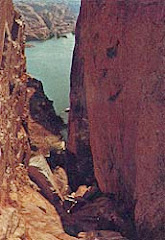
He was 2 years younger than his brother Adam Franklin Robb who was also in the Hole-in-the-Rock group as were brothers William and John.
Story taken from family history:
George Drummond Robb was born in Sydney, Australia, on September 23, 1855, the 10th child and youngest surviving son of Ellen Bell and William Robb. He was named after the father of Susannah Drummond, who would soon become William Robb’s polygamous wife. When George was two, the family immigrated to Utah, and family sources say that young George “jeopardized his chances of ever reaching the promised land by falling into the Pacific Ocean.”
There is no reference to this near disaster in the journal of the ship “Lucas,” which brought the Robb family to San Pedro, California. There is a reference in the log to a “Robb child” being near death and recovering after being “administered to.” Perhaps this was George, and the cause of his condition could well have been toppling overboard — although one imagines such an event might have been noted in the ship’s journal. Some family group sheets list George’s date of birth as Sept.1857, while the family was en route to America, but that is clearly in error. His brother William told him in a letter that he was born in Sydney, Australia — and he was there. Because of limited opportunities for education in rural Mormon Utah in the early days, George got only three months of formal schooling. On January 8, 1878, George married Caroline Jones, the daughter of William Edward and Eliza Newman Jones. She was the sister of Joseph Jenkin Jones, who married George’s half-sister Eliza Jane.
On September 1, 1878, Caroline (known as Cally) gave birth to their first child, Mary Ann. Shortly after her birth, George and his brothers William, John and Adam received a call to fill a mission in San Juan County. When asked in later years what people did with their land and homes when they accepted such a call, George answered, “We just left them behind without looking back and without any regrets.” George and Cally were never to return to Paragonah to live.
 |
| Hole in the Rock |
 |
| Ute Indians lead by Chief Buckskin Charlie Artist Unknown |
Before the family reached Paragonah, they ran out of provisions and lacked funds to buy more, so they had to stop at Price to earn money before continuing their journey. It was 1883, and the Denver and Rio Grande Railroad Company was extending its line through the Price River Canyon into Salt Lake City. George got work with the railroad, but when the job was completed, winter had set in. George and his family remained with the Henry John Mathis family until the following spring when they had decided to settle in Price.
That first year in Price, Cally gave birth to their first son on April 20, 1883, named George after his father. (Another of our frustrating discrepancies: one family group sheet lists George as having been born in Mancos, but there was no mention of a baby boy in the saga of how George got his family across the raging river, a strange omission if the infant were included.) In the spring of 1884, several families from Red Creek came to Price to make their homes, which probably contributed to the Robb’s’ decision to remain. Among the newcomers were Caroline’s sister and her husband. Without a “payroll industry,” times were often hard in Paragonah. Employment by the railroad in Price and other communities on the railroad line sustained many farmers and cattlemen during slow periods.
George bought a piece of land and built a small log house. He began to farm and over time purchased more land and a few cattle. His father William Robb gave him fifteen head of cattle to help him get started. More children came along: William (1885), Ada (1887), and Vesta (1890). George built furniture for their home. Their beds were great logs split in two and bound with rawhide strips, then covered with ticking stuffed with straw.
In the early 1890s, a diphtheria epidemic raged in Utah, and so many people died that the customary funeral services could not be held. Each morning, a great wagon went rumbling down the road on its awful mission of gathering the dead from the night before. If a white flag hung from the gatepost, the hearse stopped, picked up the loved one, and disposed of the remains. Eight-year old George had shown symptoms of the disease, so the other children stayed in the family’s granary under the care of 10 year-old Ellen. When the doctor came, he showed the worried parents the large white lumps in George’s throat. The boy was choking to death. The doctor attempted to remove the largest lump with crude surgery, but it was too late: young George died on June 27, 1891. That morning the white flag hung from the Robb’s’ gatepost.
 |
| George Robb Son of Geo; Caroline Robb Born April 20, 1883 Died June 27, 1891 |
 |
| Angus J. Robb 1905-1945 |
 |
| Angus Robb Death Certificate |
The entire family was active in the Church. When George had time and wasn’t busy with Church or his work, he earned extra cash hauling freight or passengers from Price to the Duchesne county or the Uinta Basin.
On Sunday afternoons, George relaxed by playing the reed organ in the family’s little parlor. “This towering instrument with its terraces of racks, carved panels and little shelves stood majestically at one end of the room. The tiny shelves held many candlesticks, and those candlesticks lovingly polished, gleamed in the lamplight. On the center table was a copy of the Bible, the Book of Mormon, a green plush album and a beautiful, handpainted lamp. It was a room that any man would be proud to gaze upon.”
 |
| Book of Mormon and Holy Bible |
With the expansion of the railroad, many changes came to the state. Coalmines opened in Emery County and people flocked to the area to seek work. In1906, Emery County split in two; the north portion became Carbon County and Price was its county seat. The increased population, most of whom were not farmers, gave George a new market for his produce, and the sale of his cattle brought a good price. George bought shares when a bank opened in Price. Though his savings increased, George did not find a sense of security. The early years of poverty had been so difficult that George regarded himself as a poor man all his life. He gave generously to the Church, depriving himself to do so, and contributed money toward the new high school so his younger four children would not have to leave home for their education.
On April 22, 1922, Cally died of a heart condition, and “then George learned what poverty was really like, but it was a spiritual poverty. His children were kind, generous and helpful, but they could not replace a man’s mate and companion of 45 years. He lived in the old house alone for the next 20 years. During this time, it seemed for George as though time were standing still. A steady stream of grandchildren came along. His children took him to their homes for visits.”
 |
| Caroline Jones Robb Monument Price City Cemetery Price Utah |
 |
| George Drummond Robb Monument Price City Cemetery Price Utah |
 |
| George Drummond and Caroline Jones Robb |
Sources:
Zelia Pessetto, granddaughter of George Robb, in a story sent to the Daughters of Utah Pioneers. (January, 1958, “Lesson”)
Arlin Robb, family records and personal recollections, Max Robb, notes
Virginia Cook Hunter, daughter of Vesta Robb Cook and granddaughter of George D. Robb.