Walter Simmons Robb Family

Thursday, June 23, 2011

Voyage of the Ship Windermere

Ship Windermere painting
[Click on images to enlarge]


Voyage of the Ship Windermere


Condensed from W. W. Burton’s Account

Note: This is from a copy made on March 23, 1944, from the British Mission records of 1854 by Evelyn A. Sessions. It is of interest to the Robb family as George and Sarah Green Holyoak were on board this voyage from Liverpool, England to the United States.

Ship Windermere 1852 drawing State Museum of Victoria

On Wednesday, February 22, 1854, the ship Windermere sailed from Liverpool with 460 passengers. As the vessel started in motion, the songs of Zion, blending in soul-inspiring harmony, thrilled the souls of the passengers and their many friends standing on the shore gazing at the departed vessel, shouting farewell, goodbye with eyes streaming with tears. Doubtless they were recalling that only the night before seven vessels, with all on board, went down in the depths of the channel.

H.M.S. Windermere Poop drawing
As the land disappeared in the distance the sweet singing ceased and many began to feel sick. About 8 p.m. the first day at sea, an old gentleman named Squires died. All that night the wind howled fiercely; the sea was rough; the ship was driven from its course towards the Isle of Atan. About 11 p.m. off Holly Head, which is a most dangerous point and the scene of frequent shipwrecks, was passed. On the morning of the 23rd Father Squires, who died the night before, was thrown overboard. The sea was still rough and the wind was blowing. During this day the Windermere sailed by the remains of a wrecked vessel. Masts, sails and other fragments were floating around. Likely, a few hours previous many despairing souls had tenaciously clung to these same objects for relief that never came. All had been consigned to a watery grave for no signs of life remained and the rolling waves swept over the bodies while the wind howled its tribute for the dead.

Some were now beginning to recover from sea sickness, but many were still ill, and some confined to their berths. About this time flying fishes were seen which would rise from the water and fly a short distance and drop into the water again. Life on the Windermere was growing monotonous, for its accommodations were poor for so many passengers, and then it did not sail like the ocean steamers now do when propelled by steam. The Windermere was eight weeks, four nights, and five days sailing from Liverpool to New Orleans, which can now be made in six or seven days. We were on the Atlantic Ocean about seven weeks without seeing land.

H.M.S. Windermere Between Decks drawing

On the 12th day of March, from 7 to 8 in the morning, an exceedingly fierce storm arose. The wind roared like one of our mountain winds, the masts cracked and the sails were cut in pieces. The captain of the Windermere expressed fears that the ship could not stand so heavy a sea, and in speaking with Daniel Garn, the president of the Saints on board, said, "I am afraid the ship cannot stand this storm, Mr. Garn, if there be a God, as your people say there is, you had better talk to Him if He will hear you. I have done all that I can for the ship and I am afraid with all that can be done she will go down."

Elder Garn went to the Elders, who presided over the nine wards in the ship, and requested them to get all the saints on board and to fast, and call a prayer meeting to be held in each ward at 10 a.m. and pray that they might be delivered from the danger. The waves were lashed with white foam, the storm continued in all its fury, but precisely at 10 a.m. the prayer meeting commenced and such a prayer meeting few have ever seen.

Deck of Windermere

The ship rolled from side to side. On one side the Saints were hanging by their hands, and the other they were standing on their heads. Then the ship would roll on the other side which would reverse their positions. About this time the large boxes which were tied with ropes under the berths broke loose with pots, pans and kettles and rolled with terrible force on each side of the vessel.

Although the prayers were fervent and earnest, as the pleadings of poor souls brought face to face with danger and death, they ceased their prayers to watch and dodge the untied boxes, and great confusion prevailed for some time. The wind roared like a hurricane. Sail after sail was torn to shreds and lost. The waves were very large and as far as the eye could see, seemed to be one angry mass of rolling white foam. The hatches were fastened down. This awful storm lasted about 18 hours, then abated a little, but it was stormy from the 8th of March until the 18th. Observation taken by the quadrant showed that the ship was in the same latitude as it was on the 8th.

On the 14th of March, which was two days after this terrible storm, smallpox broke out. Of the three sisters, one was taken down with it. She had a light attack and recovered, but her two sisters then came down with it and both died, and after that 37 others, 40 in all, came down with it. Three days after the breaking out of smallpox, the ship took fire under the cooking galley. At this time we had not seen land for three weeks or more; when the cry of "Fire! The ship is on fire," rang throughout the vessel, and wild excitement and consternation prevailed everywhere. The sailors plied water freely, all the water buckets on board were brought into use and soon the fire was under control.

Winderemere Cuddy painting 1847

When the last of the three sisters, who took smallpox, died it was evening. W. W. Burton thought he would get a good place from which to see the body thrown overboard; so he got outside the vessel and seated himself on the ledge extending out from the deck, placing each arm around a rope that led to the rigging. His feet were hanging over the ocean and the ship was sailing about at 10 knots. By this time darkness was fast setting in, but here he sat waiting to get a good view when the corpse would be thrown into the watery grave, where some said sharks were constantly following for prey. Brother Burton went to sleep and the funeral passed without his knowledge. The sound of feet walking on the deck aroused him from his slumber. A chill ran through him; his hair almost stood on end when he sensed his condition. Here he had been asleep, his feet were hanging off the side of the vessel which was rocking to and fro. He wondered how he had escaped falling overboard. It was now totally dark. He climbed into the ship and resolved never to expose himself so again. About this time the stench of the smallpox was fearful in every part of the vessel.


Scene on board H.M.S. Windermere 1846 painting

Emma Brooks was the name of the young lady just thrown overboard. Her sister Fanny had died the same day about half past one o’clock p.m., and was also thrown overboard about two o’clock. The funeral services were very impressive; a funeral at sea is the most melancholy and solemn scene perhaps ever witnessed, especially when the sea is calm. A stillness like that of death prevailed with us while an old sailor, at intervals, would imitate the doleful tolling of the bell of some old church, such as heard in some parts of England. Funerals were becoming frequent.

About the time the Windermere had been about six weeks out of Liverpool and the passengers had never seen land from the time they had entered the Atlantic. The days were generally mild and the weather very pleasant. The sun set and the bright, pale moon seemed to be straight above our heads. On the 8th day of April we came in sight of the Island of Cuba. On this day, about 10 a.m., a young man named Dee, died of smallpox. At the time of his death the wind had ceased blowing, not a ripple upon the waters. The sea appeared bright and clear, and seemed as smooth as a sea of glass. The young man that had just died was sewed up in a white blanket and at the feet was placed a heavy weight of coal. A plank was then placed with one end resting in the porthole in the side of the ship and other near the main hatchway. The body was then placed on this plank. The doleful tolling of the bell began. Elder McGhee made a brief address suitable for the occasion and offered a short prayer, after which the body and bedding of the young man were thrown overboard. The ship was standing perfectly still and the body could be seen sinking in the water until it appeared no longer than a person’s hand. Some thought it was seen sinking for a full 15 minutes, others still longer; some said a half hour.

The passengers of the Windermere had passed through a terrible storm, the panic created by the ship taking fire, their number decreased by smallpox, still another fearful calamity threatened them. The fresh water supply was getting short, and the store of provisions was falling. The passengers were limited to one hard, small sea biscuit for a day’s rations.


Windermere in the Trades 1846

The Captain sent some sailors in a small boat to intercept a ship that was passing in the hopes of getting more provisions, but they failed. The Windermere now passed the western points of the Island of Cuba. The passengers had a good view of the lighthouse located on the most western point. The Gulf of Mexico was before them. The Gulf Stream flowed in like a vast river. Just think of this stream 500 miles across, very deep and constantly flowing.

On the morning of the 20th of April the ship entered the mouth of the Mississippi River. The passengers were more glad to look upon the plantations of orange groves that bordered the banks of the river than the great strong surging waves of the Atlantic which they had left behind them. Sometimes the Negroes would call from the shore and bid the emigrants welcome.

The Windermere set sail 22nd of February 1854 from Liverpool, England, arrived at New Orleans 23 April, 1954. During the voyage winds were encountered, arising at times to heavy gales. But at the end of five weeks favorable winds set in and the ship made 1,000 miles in four days.

Six marriages were solemnized on board, six births and 10 deaths occurred.

Millennial Star, Vol. 16, pp. 140, 193, 345, 477
Church Emigration. Vol. 2 p. 185—1868

Of the Craner family who were on this ship, the father, George Benjamin Craner, died of Cholera while crossing the plains to Salt Lake City. He was buried in the same grave along with a young girl and a child. Because the people were dying so fast, they didn’t have time to dig enough graves.

Windermere shortening sail to answer signal of distress of the whaler St. Peter,
off New Bedford, Dec 16 1846.  Windermere hove to St. Peter making after
her capsized whale boat.  Unrelated to this voyage but interesting history.

____________________________
Source:
http://www.craner.org/index.php?option=com_content&task=view&id=18&Itemid=30

Alexander Robb

Alexander Robb 1853-1926

Birth: Jan. 21, 1853


Sydney, New South Wales, Australia

Death: Jan. 15, 1926
Paragonah, Iron County, Utah, USA


Alexander was the son of Ellen Bell and William Robb. He married Ellen Benson on July 9 1877 in Parowan, Utah. He was the father of six: Martha, Alexander, Margaret Ellen, Mary Elizabeth, Alice Ann, and Pearl.

He worked as a freighter taking surlus grain, butter, cheese and eggs to mining camps at Dlamar, Pioche Nevada, and Silver Reef in Washington co Utah. He was also a dairyman and a cattleman.


Alexander Robb Death Certificate


Alexander Robb Monument Paragonah, Utah Cemetery

Burial:


Paragonah Cemetery
Paragonah, Iron County, Utah, USA
Find A Grave Memorial# 9904231

Tuesday, June 14, 2011

William Robb Brand 1866 Paragonah

William Robb Brand 1866 Paragonah Utah
Originally, I was exited about finding information on this brand thinking it was gg-grandpa William Robb's brand.   Then I realized it must belong to his son William Robb Jr.  In 1861, William and his young polygamist wife Susannah Drummond Robb left Paragonah when he was called to the Cotton Mission in Harrisburg, Utah.  He left  Helen and their children to make their own way in Paragonah.  The brand is still significant, as it would have been used to identify horses and cattle that were owned by the Helen Robb family, with William Robb Jr as the male head of household.

William Robb Brand


Friday, June 10, 2011

Marion Milton Robb - Missing Poster

Marion M. Robb Missing Poster
Reference:
Created by: Cracraft Proud
Record added: Nov 15, 2004 
Find A Grave Memorial# 9904299


Birth: Oct. 25, 1908
Spry Garfield County Utah, USA
Death: Jun. 6, 1926 Utah, USA

Marion was the son of Eliza Barton and Albert D. Robb.

The circumstances of his death is still a mystery.

Iron County Utah Sheriff's Office Poster:

MISSING On June 5 1926 Marion M. Robb was working on the sheep range of his folks several miles north and east of Paragonah Utah when he mysteriously disappeared. The surrpounding country was thoroughly searched by 500 neighbors and friends but not a trace was found. If you have any information communicate with his parents or this department. J.T. Leigh, Sheriff

Marion's remains were found Oct 28 1933. There were wires still wound around the arms and legs, and evidence of a gag still in place.

Place of Death: East Cottonwood Canyon
Burial: 11/6/1933

Burial:
Paragonah Cemetery
Paragonah Iron County Utah, USA


Marion Milton Robb Death Certificate


Marion M Robb Monument Paragonah Utah Cemetery

Tuesday, June 7, 2011

Thomas Robb - Indian War Veteran

Thomas Robb
INDIAN WAR VETERAN DIES AT PARAGONAH
Cemetery name Paragonah Cemetery

Name on headstone Thomas Robb
Birth 1848 - Sindney, Australia
Death 1931 - Paragonah, Utah


INDIAN WAR VETERAN DIES AT PARAGONAH


Thomas was the husband of Alice Tattersall Robb, married Feb 27, 1871 in Salt Lake City. It took five weeks for them to make the trip to Salt Lake and back to Paragonah. He owned the first grain grinder in Paragonah.

Thomas Robb, 83, resident and prominent citizen of Paragonah since 1857, and veteran of the Black Hawk Indian War died at his home on Monday, June 22, after a lingering illness of several months during which he suffered much.

He is survived by three children, Mary E. Prothero and Thomas W. Robb of Paragonah and James Robb of Salt Lake City, his wife having preceeded him in death by thirteen years. An account of the funeral service which was held yesterday afternoon will be found with other Paragonah news on the back page of this issue.

Mr. Robb was born in Sydney, Australia, May 15, 1848, one of the family of nine boys and three girls, children of William and Helen Bell Robb. With his parents he emigrated to America at the age of nine years, landing at San Pedro, California in 1857. They came on to Utah the same year with a company of Mormon converts and after a short sojourn at Cedar City, then Cedar Fort, they moved to Paragonah where he has since resided.

He was mustered into service during the Black Hawk Indian War on August 16, 1866, in Captain James Andrus' company and saw active service as a minute man. He was married to Alice Tattersol on February 27, 1871 in the endowment house in Salt Lake City.

He was a successful farmer and livestock man and a good citizen, contributing liberally of his time and money for the public good. He devoted much of his time in later years and spent considerable money in genealogical research and temple work for his family.

A large number of out-of-town people were here for the funeral, among them his brother George and the latter's son Orlo of Price, his daughter-in-law Mrs. James Robb and grand daughter Elaine of Salt Lake City.

Parowan Times

6/26/1931


Headstone Details

Thomas Robb Death Certificate


State of Utah--Death Certificate Thomas Robb Born: May 15 1848, Sidney (sic) Australia Died: June 22, 1931 (Age 83 Years, 1 month, 7 days) Burried: Paragonah, June 25, 1931 Wife: Alice Tattersal Robb Father: Wm Robb Sr., born in Scotland Mother: Ellen Bell Robb, born in Scotland


Thomas Robb Indian War Affidavit


Thomas Robb Indian War Affidavit


Thomas Robb monument Paragonah Cemetery, Paragonah, Utah


Source:
Indian War Affidavit

Franklyn Adam Robb Wedding 1905

 Franklyn's wedding to Mary Taylor
29 April 1905 in Parowan, Utah
This photo is of Franklyn's wedding to Mary Taylor 29 April 1905 in Parowan.  The woman next to the groom is Sarah Permelia Holyoak Robb Wardell.   Assistance in identifying other individuals in this photo will be greatly appreciated.

Frank and Mary's Wedding Photo
29th April 1905 Parowan, Utah
Sarah Permelia Holyoak Robb Wardell
seated on Frank's left


____________________________
Source: Hole-in-the-Rock

Saturday, May 28, 2011

Answering the Call

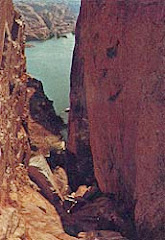
Hole-in-the-Rock: When the wagons went
down this trail it was twice as long as it is today
Written by Georgia Robb Drake, grand-daughter to  Heber William Robb.

In studying the historical reports and diaries of the Hole in the Rock participates, as the time neared there was much excitement and anticipation for this new adventure to begin.  Throughout the summer of 1879, while emigration routes were being explored, families were rounding up livestock, disposing of property and acquiring sturdy wagons, necessary supplies and equipment.  "Ho for the San Juan" became a common greeting throughout Southern Utah.  Yes, I was concerned for those families, men, women, and children, full of faith, enthusiasm and courage, ready to take on an unparalleled expedition in untamed territory. Trusting scouts who were sent to determine the best route and feasibility of road building through the broken terrain returning with favorable reports, had done their job well. Trusting the land would be suitable for farming, trusting mostly in God.

A Utah newspaper described Utah's southeast corner in 1861, as "one vast continuity of waste and measurably valueless, except for nomadic purposes, hunting grounds for Indians and to hold the world together." The Mormons wanted to establish an outpost settlement to bring the word of God to the Indians and act as a neutral point of rendezvous of the southern Navajo tribes, and the war-like Ute and Paiute tribes to the north.  Many of those who inhabited this area did so by raiding and pillaging the Mormon settlements west of the Colorado. "One writer reported that at one time twelve hundred head of stolen cattle were driven across the Colorado at the Crossing of the Fathers. Losses to the raiders, in sheep, cattle, and horses, were estimated at more than one million dollars a year."This was such a harrowing experience, the accomplishment of those who went through the "Hole" is remembered with great respect. Then I wondered, would I have gone if I had been called? The answer is, Yes. I hope I would have the same faith and courage these brave pioneers showed, and retained under such adverse situations.


Great Grandmother Sarah P. Holyoak Robb worried about the outlaws who had made the difficult terrain their home. It is said that Solomon Wardell urged Sarah not to go on the expedition. Whether he did or not, Sarah, her husband Adam Franklin Robb and two sons, Albertus (4) and William Heber (2) were  among those daring pioneers of the San Juan Mission.  Adam's brothers George Drummond Robb and family, William and his family,  John and family were also among those called.  John also known as Jack and Thomas were driving a head of cattle to the San Juan. 


They were not just pioneers, before they left, each had been called on a mission.  The San Juan Mission. They were more than pioneers, they were missionaries with a call to colonize the four corners.  Among this incredible band, were two professional road builders.  They were paid $1.50 a day, very good wages for that time.  When they joined the group, the pioneers had already taken the wagons down the first huge obstacle, "The Hole".  Other equally daunting challenges lay ahead.  When they came to the next mammoth task, the paid road builders could not conceive of an answer to the challenges they had to overcome.  Overwhelmed, they finally gave up and went back to Salt Lake City, saying it couldn't be done.  Meanwhile, the Missionaries filled with faith in miracles and undying  determination faced those same obstacles together.  They solved their problems one after another until at long last, they reached their destination.  Starvation, freezing cold, hostile Indians, impossible feats of engineering and road building.  They faced them all with faith and courage, and proved their worth with every footstep.  

 I suspect the members of the San Juan Mission would tell anyone who questioned the wisdom of taking on such a harrowing journey, that their faith grew and miracles were experienced by all.  Today, anyone who looks at the extreme grade and narrow passage of the Hole in the Rock must do so with awe and wonder.  I am grateful my great grandparents were faithful in their role.  Not all stayed after they arrived, but none left without first receiving an official release from their mission call.  My grandfather William Heber Robb was only about 2 years old when he participated in this epic journey.

We Thank Thee Oh God
Hole-in-the-Rock

By David Miller

Appendix XI pp. 208

THE GEORGE B. HOBBS NARRATIVE

In Chapter VII of this work George B. Hobbs tells of the experiences of himself, George W. Sevy, Lemuel H. Redd, Sr., and George Morrell who were sent from the Hole-in-the-Rock to scout the country ahead in an attempt to locate a possible route all the way to Montezuma. The narrative found on the following pages is a continuation of Hobbs’ account in which he tells of his second expedition from the Colorado River to Montezuma, this time with provisions for the relief of the families which had been located there since the previous summer.

This account is copied from the San Juan Stake History, L.D.S. Church Historian’s Library.

After working some time on the road, which the company at the Hole-in-the-Rock were making by blasting, etc., down to the Colorado River, I returned to my camp at Fifty Mile Spring to get supplies and my mules in order to join Dan Harris on a return trip with supplies for our people who were starving at Fort Montezuma. Making inquiries from those who had promised to look after my mules while I had been away [on the exploring expedition] I discovered that they had neglected to keep their promise, and no one knew anything about my mules or where they were. Riders had been back as far as Escalante and had practically traveled all over the section of country lying between the Kaiparowitz Plateau and the Escalante Gulch, and no one had seen my mules since I had left. I started out to find them, going about 6 or 7 miles from camp. But finding no grass whatever I knew my animals would not stay in such a desert county. My belief was that they would try to make for their former home in Parowan. Returning to camp with this belief, I decided the next day that I would quit the camp altogether as I did not like the way the brethren had treated me in this matter, while I had been exposing my life to explore the road for them.

Therefore, I set out alone early one morning, in February [January] 1880 with a supply of crackers and my blankets with the intention of returning to my home. After going a mile or so I was impressed to lay my griefs before my God and kneeling on a smooth rock I uttered a few words of prayer, asking God to direct me in what I should do. The impression came to me that I should keep to the west side of all horse tracks. This I did, and after traveling a short distance I found some tracks leading up the steep barren clay hills toward the Kaiparowitz Plateau Cliff. I followed the tracks almost to the cliff where I found a narrow bench covered with abundant bunch grass, and here were my mules, fat as they could be, together with one other animal which the company had thought dead. This happy discovery came, as I always believed, as a direct answer to my prayer. Once before, when on my first trip, my prayers had been answered in a similar way, when I besought God to direct me which way to go, we having lost our bearings. He answered it by impressing me that I should follow the canyon to a certain place where I found a large cottonwood growing. This I did and found it was the only way we could get out. This simply meant the saving of our lives as we were starving, being without food in the cold snow, after having lost our trail.

Dan Harris returned from Escalante with supplies, and as it had been prearranged that I should return with him to bring supplies to those at Montezuma, we traveled together to the Hole-in-the-Rock near the Colorado River and then crossed the river, I fording the river with my horses, his horse being already on the other side. Taking our supplies in a boat, we camped about three miles on the east side of the river the first night. A heavy snow storm overtook us, and as the indications were that it would continue I refused to go further until the snow abated, starting it was better to have the snow under feet than over head. Bro. Harris became quite angry at my suggestion to stay a day or so and went [pp 210] back to the river where he persuaded two California miners (father and son) who were with the party to accompany him.(1)

Some of the brethren had gone about four miles further ahead to work on the road in order to make it easier for us to get out with our pack animals. When Bro. Harris passed these men they asked where I was. He answered that I had refused to start in the snow storm, and he was glad of it, as I wanted to go by way of the Elk Mountain, and he knew he could go up the San Juan. He then said, “Tell Hobbs that I will meet him on the road.” It pleased the brethren to think that a shorter way might be found, as I had held to my opinion that my way was the only way to get through.

I now stayed and worked on the road three weeks longer as I wished to get my wagons across the river. (2) The storm continued most of the time. When I got ready to start I asked for a volunteer to go with me but none would go. Bro. Sevy said no man could live and go through those cedars with the snow which must be on the ground. I said that I would go, as I would never live to know that women and children were starving to death for the want of an effort on my part.

The next morning I placed the packs on my mules, tying the head of one to the tail of the other and leading the first one. In this way I traveled the entire distance, going on foot myself. The second day, when I cam to the slick rocks, I looked back and saw a band of horses following me with men driving them. When they reached me at the bottom of the rocks I found it was Jack and Adam Robb, formerly of Paragonah.(3) They told me they were going to leave their horses at the Lake and accompany me through, as they had been off their homesteads near Farmington, New Mexico, for six months and were afraid someone might jump their claims.

We made good time, following the back bone or dividing ridge between the Colorado and San Juan Rivers toward the Elk Mountains, the snow getting deeper every mile we traveled. The weather was so cold that the snow was not crusted. Five days I spent in these cedars and gulches with the snow up to my chin. I had to cut trees out of my way in order to get through and my mules did not have a mouthful of food during this time. On Feb. 22nd, 1880 (my 24th birthday), I got out of this deep snow into a branch of the Comb Wash where the ground was bare. Here my mules would eat a little grass and then roll in the sand, which seemed to give them much pleasure, after being in the snow so long. The next day was good traveling down the Comb Wash.

Passing the Harris camp (4) the following day I reached Montezuma. Geo. Harris road out overtaking me, (5) asking me how long I had been on the road. I answered that this was my ninth day. He said, “You have made good time.” I asked him when Dan Harris had got through. He said “Yesterday,” and explained that he and his companions had eaten up all his supplies. He had been wandering in the deep snow 29 days (6) from our camp in the Hole-in-the-Rock. Geo. Harris desired to buy some of my supplies but I stated that no money on [pp. 211] earth could buy them, as they were sent to relieve those who were starving at Montezuma.

George and his brother Dan immediately got ready to return on my tracks to the main camp, which they did, reaching the camp at Cheese Ranch, about 10 miles east of the Colorado River. Inquiries were made as to whether they had seen me. They answered, “Yes, he got through, and for God’s sake if there are any of the rest of you that want to get through, you had better follow his tracks!”

It was a joyous moment for those starving Montezuma people when they saw me coming over the hill with the white sacks of flour on the packs. They had been watching for nearly a week, as the 60 days of promise were just expiring (my companions having on our first trip stated we would return with food in 60 days, they believing they could hold out that long).(7) They had but one pint of wheat left when I arrived and had not tasted flour for over four months. I stayed with these people 20 days while the Robb boys went up to Farmington and worked on their homesteads. Upon their return I joined them.

Just previous to our return a cowboy carrier [courier] had brought word to Montezuma Fort that the White River massacre (in which the Meeker family were massacred by Indians) had occurred and for us to be on the lookout as well as those at the fort.(8) Before leaving the camp at Cheese Ranch I had agreed upon a system of signals on any prominent ridge that I might cross to guide the company which way to come, my signals were three fires in a triangle. On the third way out we were making toward the Elk Mountains, arriving at a prominent ridge about noon. I made my first signals, which were immediately answered by a signal fire on the side of Elk Mountain. We were pleased to think that we would be with company again that night. No sooner had we started towads their fire in the afternoon and gone down into a box canyon than we came across the fresh trail of the Indians fleeing into the country west of the Elk Mountains. They had passed but an hour or so before. Not knowing whether the fire we had seen was an Indian’s signal fire or our friends, made our going dangerous, as we expected to be shot from every turn in the trail, my companions preferred that I go in the lead, they keeping well behind. I still had confidence in my God that he would preserve us, as he had done before. We found by the sign which the Indians’ horses had left that we were gaining on them as it made traveling for us much better than for them as they beat down the snowdrifts.

These Indians ran into our brethren’s camp about an hour ahead of us, retreating into the hills immediately not knowing but what our people were hostile toward them. They sent a squaw in, and our people gave her some clothes and food. Then others ventured in, they asked about us, but the Indians said they did not know anything of our whereabouts, although we were behind them. The men immediately came to the conclusion that they had killed us as they seemed so ignorant of our whereabouts. Six men immediately started out back on their trail expecting to find our dead bodies. They met us about half a mile from their camp. I then told them of the Meeker massacre and that perhaps [pp. 212] these were the Indians that were getting away. They immediately threw out guards to protect the camp and stock.

They had agreed to bring my wagon with them, but I learned it was where I had left it. This necessitated me going back after it. I met many different parties that were on their way to catch up with the main camp which was now at the Elk Mountain. The weaker ones were in the rear, some had an ox and a mule hitched together, some had cows and heifers in their teams, one I noticed was a pair of mules with an ox on the pike with a young girl riding the ox, to keep him in the road, all made inquiries of me how far it was to San Juan. The Robb boys accompanied me back as far as the Lakes staying there four days while I returned alone to Cheese Ranch for my wagon. In places where I could not get up the hills with my load wagon (having no help) I packed the supplies from my wagon onto pack mules, then came back for the wagon.

On April 4th, 1880, we overtook the main company at a place now called Rhen Cone on the San Juan River. (9) Next day we pulled up a steep dug way that had just been completed, (10) and the following day (April 6th 1880) we arrived at the point on the San Juan where Bluff City now stands. Much disappointment was experienced by members of the company of about 225 souls on their arrival for they had expected to find a large open valley, instead they found a narrow canyon with small patches of land on each side of the river. Wm. Hutchings of Beaver was the man that named the place Bluff City on account of the bluffs near by.(11)

The next day (leaving camp here) I pulled up to Ft. Montezuma which was my destination. The company now began the general work of colonizing, taking out the water, building water wheels, putting in crops, etc. I had promised Silas S. Smith who was captain of our company who was home at Paragoonah that I would let him know when the company got through, I just had time to scribble a letter to him sending it to Mancos (125 miles away) by a cowboy who was just leaving, to that effect, this being the first news to get back to Utah of the company getting through.(12)

Footnotes

1- Hobbs, and Harris had camped on Cottonwood Creek when the storm struck. These California miners are mentioned in numerous accounts but are never given further identification.

2- During this time Hobbs did get his outfit across the river, probably coming across with the rest of the wagons from Fifty-mile camp late in January 1880. He took his wagon as far as Cheese Camp before finally setting out with packs for Montezuma, as is “indicated by later references in this account. Although Hobbs uses the plural, “wagons” in this one place, it seems quote obvious that he had but one.

3- Platte D. Lyman’s journal entry for February 15, states that four men started for the San Juan with pack animals that day. This number probably included Hobbs, and the Robbs. This checks about right with later statements by Hobbs, that he arrived at Comb Wash on February 22 and at Montezuma two or three days later, having traveled 9 days from Cheese Camp. James Dunton and Amasa Barton had also taken a herd of horses ahead of the main company from Cheese Camp, according to the Lyman record.

4- At the site of Bluff.

5- George Harris rode out of the Harris camp at Bluff and overtood Hobbs as he was passing by on his way to Montezuma.

6- Hobbs had spent nine days, having left Cheese Camp February 15. He and Dan Harris had originally crossed the Colorado to begin their trip together about January 23 or 24.

7- In his Desert News (December 29, 1919) account Hobbs says: “I having on my first trip stated I would return with food in 60 days.”

8- For an account of this massacre see LeRoy R. Hafen (ed), Colorado and its People, I, 381-86 It is hardly likely that the Indians Hobbs followed into camp three days later were members of the Meeker Massacre party.

9- Rhen Cone! -- bend or corner. This is where the San Juan cuts through Comb Ridge. It is the site of the later Barton trading post where Amasa Barton was killed by an Indian a few years later.

10- San Juan Hill.

11- As far as I have been able to learn, this is the thinly account that gives William Hutchings credit for having suggested the name of Bluff City. I see no reason to doubt it. When the U.S. Post Office Department was preparing to establish an office there, the name was shortened to Bluff.

12- In his Desert News account, Hobbs states: “My father, who lived at Parowan, had promised Silas Smith, who was still at his home in Paragonah … that he would let him know when he got a letter from me saying the company got through…”

APPENDIX I
HOLE-IN-THE-ROCK PERSONNEL

B. Personnel Of The Hole-IN-The-Rock Expedition:

Gurr, William Heber (Parowan) Family Friends traveled to U.S. on Ship Lucas w/Robbs
Anna Hanson
  William John

Holyoak, Henry (Paragonah) [Sarah Permelia’s Uncle]
Sarah Ann Robinson
  Alice Jane
  Henry John
  Mary Luella
  Eliza Ellen
  Albert Daniel

Robb, Adam Franklin (Paragonah)
Sarah P. Holyoak
  Albertus
  William Heber

Robb, George (Paragonah)
Sarah Ann Edwards
  Ellen Jane
  Sarah Ann

Robb, William (Paragonah)
Ellen Stones
  William

C. Persons Sometimes Listed As Among The Hole-In-The-Rock Company But Without Definite Proof:

Robb, Alexander
Robb, Samuel (Son of William Robb and Susannah Drummond)
Robb, Thomas